Employment Rules for Foreign Residents in Korea
Foreign residents in Korea often assume that finding a job is mainly about contracts, salary, and qualifications. In practice, however, employment is also closely tied to immigration status. A job opportunity that looks simple from a labor perspective may still become problematic if the visa does not permit that type of activity.
This is why employment in Korea should generally be understood through two systems at the same time: the labor system and the immigration system. The labor system focuses on the employment relationship itself, while the immigration system focuses on whether the foreign national is legally allowed to engage in that work at all.
For many foreign residents, confusion begins at exactly this point. A person may be legally staying in Korea, but that does not automatically mean all work is permitted. In many cases, what matters is not just whether the person has a visa, but whether that visa allows a specific type of paid activity, under specific conditions, and sometimes only after separate approval from immigration authorities.
This article explains the general structure of employment rules for foreign residents in Korea, how visa categories affect work eligibility, and why unauthorized employment can create serious immigration issues even when the work itself appears minor or temporary.
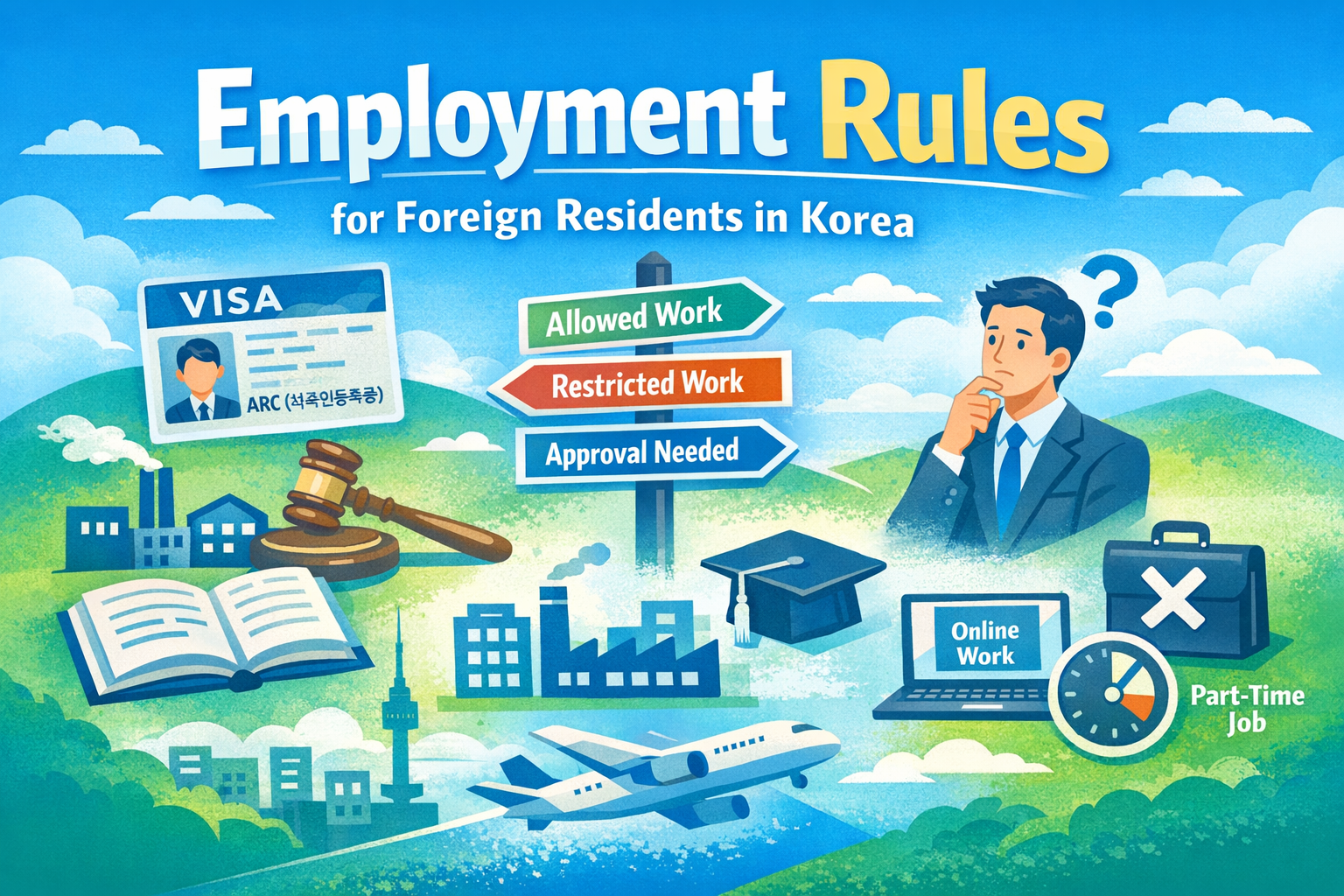
Why Employment Rules in Korea Are Not Just About Having a Visa
One of the most common misunderstandings is the idea that “legal stay” and “legal work” are the same thing. In Korea, these are related but separate concepts.
A person may have lawful stay status, but their visa may still limit:
- whether they can work at all,
- what kind of work they can do,
- where they can work,
- how many hours they can work,
- and whether prior approval is required.
This means employment is not determined only by whether a company wants to hire someone. It is also determined by whether the individual’s current status of stay supports that activity under immigration rules.
In practice, this creates a visa-based employment structure. The question is usually not “Can foreigners work in Korea?” but rather “Can this visa holder perform this type of work under these conditions?”
That distinction is the foundation of the system.
The Basic Immigration Principle: Work Must Match the Visa
In general, Korea’s immigration system is structured around the idea that activities should match the granted status of stay (체류자격). This includes employment.
That means a foreign resident’s visa is not simply a residence label. It is also a legal framework that defines what kind of activity is expected or permitted during the period of stay.
For example, some visa categories are primarily designed for:
- employment in a designated field,
- family-based residence,
- study or training,
- business or investment,
- or long-term residence with broader activity rights.
Because of this, work permission is not uniform across all foreign residents. Two people may both be living in Korea lawfully, but one may be free to work in many sectors while the other may need prior permission even for part-time work.
This is why employment issues often arise not from bad intent, but from a mismatch between visa purpose and actual activity.
Broadly Speaking, Foreign Residents in Korea Fall Into Three Employment Categories
Although the actual visa system is more detailed, employment rules can generally be understood through three broad categories.
1) Visas That Usually Allow Only Specific Employment
Some visa types are closely tied to a particular employer, occupation, or field of activity.
This structure is common in employment-based visas such as certain professional, technical, or sponsored work statuses. Under this model, the foreign resident is generally allowed to work only within the approved scope connected to the visa.
That may mean the person is expected to work:
- for a particular company,
- in a particular occupation,
- at a particular workplace,
- or under conditions already reviewed by immigration.
If the person changes employer, work location, or work content, separate reporting or permission may be required depending on the circumstances.
This is where many compliance issues begin. A person may assume they are simply “changing jobs,” while immigration authorities may view the situation as a change in permitted activity.
2) Visas That May Allow Work More Broadly
Some foreign residents have statuses that generally allow broader employment flexibility.
This may include certain family-based or long-term residence categories such as F-series visas depending on the specific status, conditions, and any attached limitations. In practice, these categories often provide a wider scope for lawful economic activity than employer-tied visas.
However, “broader” does not necessarily mean “unlimited.”
Even when a visa generally allows employment, some jobs may still require:
- separate licensing,
- sector-specific registration,
- labor law compliance,
- or restrictions based on other Korean laws.
In other words, immigration permission and business or labor legality are still separate issues.
3) Visas That Usually Restrict or Limit Employment
Some statuses are primarily intended for non-employment purposes, such as study, training, or temporary stay.
In these cases, paid work may be:
- prohibited entirely,
- allowed only in limited circumstances,
- or permitted only after separate approval.
This is especially important for international students and short-term residents. Many people assume that small-scale, casual, or online work “does not count,” but immigration systems often look at whether the activity is effectively remunerated labor, not whether it feels informal.
This is one of the most misunderstood areas in practice.
Not All “Work” Looks Like Traditional Employment
A major source of confusion is that immigration authorities do not always evaluate work only through the narrow idea of a full-time office job.
From an immigration perspective, “employment” or “work activity” may include a wide range of income-generating actions, depending on the facts.
This can include situations such as:
- part-time work,
- freelance or contract-based activity,
- tutoring or private instruction,
- platform-based gig work,
- side jobs,
- online paid services,
- performance or event-based work,
- and in some cases, self-directed commercial activity.
This matters because some foreign residents mistakenly assume that only formal employment contracts are regulated. In practice, the issue is usually whether the person is engaging in a profit-making or compensated activity that falls outside the visa’s allowed scope.
That means even side income can become an immigration issue if it does not match the permitted activity under the visa.
Part-Time Work Is One of the Most Common Risk Areas
Part-time work is often treated casually by foreign residents, especially students or dependents, but immigration systems usually do not treat it casually.
In Korea, part-time employment may be permitted in some cases, but often only when certain conditions are met. Depending on the visa and circumstances, these conditions may involve:
- prior approval,
- limited work hours,
- restrictions on workplace type,
- academic standing requirements for students,
- or limitations on the kind of job performed.
The important point is that part-time work is not automatically “safe” simply because it is small in scale.
From an immigration standpoint, even a few hours of paid activity can become problematic if the visa holder did not have the right to do that work in the first place.
This is why many immigration issues do not begin with large violations. They often begin with what the individual believed was “just a small side job.”
Employer Responsibility Also Matters
Employment compliance in Korea is not only the foreign worker’s issue. Employers also carry responsibility.
In practice, employers are generally expected to check whether a foreign national is legally allowed to work in the intended role. Hiring someone without confirming visa compatibility can create compliance problems for both sides.
This is especially important for:
- restaurants and cafés,
- academies,
- small businesses,
- logistics and warehouse operations,
- factory or manual work environments,
- and service-sector employers using short-notice labor.
Many problems occur not because the job itself is inherently prohibited, but because the employer and worker both assumed that “if the person has an ARC, it should be fine.”
That assumption is often too simplistic.
A valid residence card (외국인등록증, ARC) does not by itself prove that all work is allowed. The real issue is whether the visa status and activity match.
Unauthorized Employment Can Affect More Than Just the Current Job
When foreign residents hear “unauthorized employment,” they often think only of the immediate job. But the immigration consequences can extend much further.
Depending on the facts, unauthorized work may affect:
- visa extension reviews,
- future change of status applications,
- permanent residency eligibility,
- naturalization-related credibility,
- or overall immigration record evaluation.
In some cases, even if the person is not removed from Korea immediately, the issue may remain relevant later when immigration authorities review the person’s history more closely.
That is why employment compliance should not be viewed only as a short-term technical issue. It can become part of a long-term residency record.
For foreign residents hoping to stay in Korea over the long run, this point is especially important.

Changing Jobs Does Not Always Mean Automatic Work Continuity
Another common misunderstanding is that if someone already has a work visa, they can simply move to another company whenever they want and keep working without any additional immigration step.
In practice, that is not always how the system works.
Depending on the visa type and the nature of the change, a job move may require:
- reporting to immigration,
- updated documentation,
- employer-related review,
- or in some cases, formal permission or status adjustment.
This is particularly relevant when the new role is materially different from the old one. A change in job title may not matter in one case but may matter significantly in another if the underlying activity has changed.
From an immigration perspective, the key question is usually not “Did the person stay employed?” but “Is the new activity still legally aligned with the granted stay status?”
That is a more technical question than many people expect.
Self-Employment and Business Activity Require Separate Attention
Some foreign residents assume that if they cannot work as an employee, they may still be able to earn money independently. In practice, self-employment and business activity can raise even more immigration questions.
Running a business, registering a business entity, offering paid services independently, or operating as a freelancer may involve a different legal analysis from ordinary employment.
This is because self-directed income activity often intersects with:
- immigration law,
- business registration rules,
- tax reporting obligations,
- and sector-specific licensing or permit systems.
A visa that does not clearly support business or independent commercial activity may not automatically allow it just because there is no employer involved.
This is an area where foreign residents often underestimate the legal structure.
The Safest Way to Understand Employment Eligibility: Ask Three Questions
When trying to understand whether a job or paid activity is generally lawful under a Korean visa, the most useful framework is often this:
1) What is the primary purpose of the current visa?
Is the visa based on employment, study, family, investment, residence, or another category?
2) Does the proposed activity match that visa’s expected scope?
Does the job align with what the visa category is generally designed to permit?
3) Does the activity require separate permission, reporting, or licensing?
Even if the work seems broadly allowed, is there a procedural step or additional legal requirement that still applies?
These three questions do not replace formal case review, but they do reflect how the system is generally structured.
Final Takeaway: In Korea, Work Permission Depends on Structure, Not Assumption
For foreign residents in Korea, employment is not simply a matter of opportunity. It is also a matter of legal fit.
The most important thing to understand is that immigration authorities usually do not evaluate work only by job title or common sense. They evaluate whether the actual activity matches the legal framework of the person’s stay.
That is why many employment-related immigration issues arise not from obvious misconduct, but from structural misunderstanding:
- assuming legal stay means free work rights,
- assuming part-time work is always minor,
- assuming a side job does not count,
- or assuming changing employers is purely an HR matter.
In practice, Korea’s immigration system is designed around category, scope, and consistency.
For foreign residents, the key is not simply “Can I work?”
It is more accurately: “Is this kind of work legally consistent with my current status of stay in Korea?”
That is usually where the real answer begins.

FAQ
1) Can all foreign residents work in Korea if they have a valid visa?
No. In general, work eligibility depends on the specific visa category and the type of activity involved. Legal stay does not automatically mean unrestricted work permission.
2) Is part-time work always allowed for foreign students in Korea?
Not necessarily. In practice, part-time work often depends on visa conditions, approval requirements, work-hour limits, and the type of job.
3) Can I do freelance or online work while living in Korea?
Depending on the visa and the nature of the income activity, freelance or online work may still raise immigration issues. It is not automatically outside the employment rules.
4) If I change employers, can I keep working immediately?
Sometimes yes, but not always. Depending on the visa and job structure, reporting or immigration approval may still be required.
5) Does a residence card (ARC) mean I can legally work anywhere?
No. The ARC confirms registered stay status, but lawful employment still depends on whether the work matches the visa’s permitted scope.


