Change of Status of Stay in Korea: Basic Structure
Introduction
In Korea, a foreign national’s legal stay is governed by a system known as “Status of Stay” (체류자격) under the Immigration Act (출입국관리법). Each foreign resident is permitted to remain in Korea only within the scope of a specific status, which defines the purpose, duration, and permitted activities of stay.
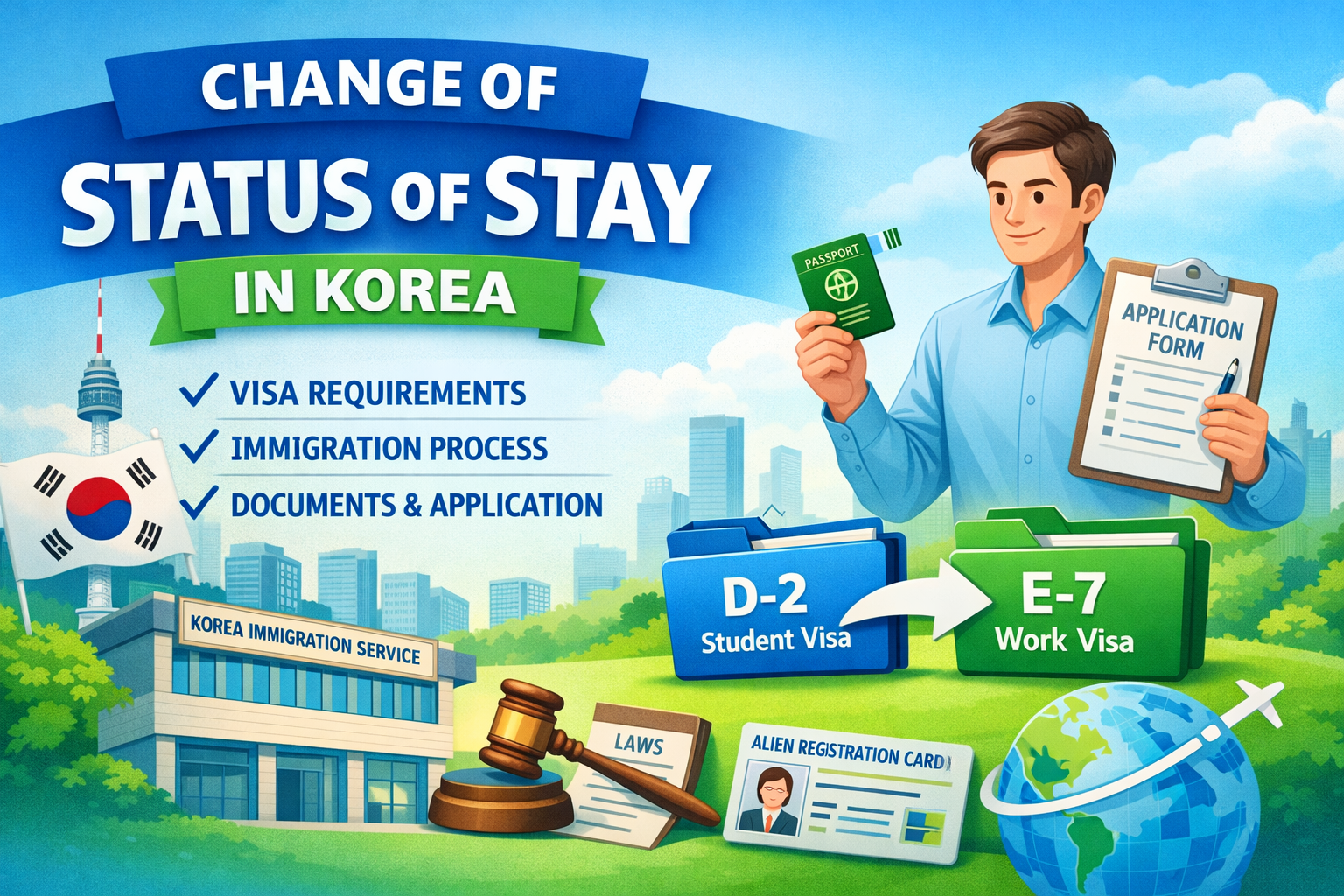
A “Change of Status of Stay” (체류자격 변경) refers to a formal administrative procedure through which a foreign national seeks approval to move from one legally recognized status to another without departing Korea. This process is regulated by the Korea Immigration Service (출입국·외국인청) under the authority of the Ministry of Justice (법무부).
This article explains the general structure of the system, how it operates in practice, and what foreign residents should understand when navigating a change of status.
1. Legal Foundation of Status of Stay in Korea
1.1 What Is a Status of Stay?
Under the Immigration Act (출입국관리법), a Status of Stay (체류자격) determines:
- The legal purpose of a foreign national’s stay
- The type of activities permitted
- The maximum duration of stay
- Whether employment is allowed
- Whether dependents may accompany
Examples include:
- D-2 (Student Visa, 유학)
- E-7 (Specialty Occupation Visa, 특정활동)
- F-2 (Resident Visa, 거주)
- F-6 (Marriage Migrant Visa, 결혼이민)
- D-10 (Job Seeker Visa, 구직)
Each status operates as a legally distinct category. It is not simply a label; it defines the legal boundaries of residence and activity.
1.2 Principle of Activity Limitation
A fundamental principle in Korean immigration law is that a foreign national may engage only in activities corresponding to the granted status of stay.
For example:
- A D-2 holder is generally limited to academic study.
- An E-7 holder may engage in employment within the approved occupation.
- A D-10 holder may conduct job-seeking activities but not full-time employment.
If the purpose of stay changes—such as graduation, employment, marriage, or business establishment—the existing status may no longer reflect actual activities. In such cases, a formal change of status may become necessary.
2. What Is a Change of Status of Stay?
2.1 Definition
A Change of Status of Stay (체류자격 변경) refers to an administrative approval that allows a foreign national to transition from one recognized status to another without exiting Korea.
This is different from:
- Extension of Period of Stay (체류기간 연장) – maintaining the same status but extending the duration.
- Re-entry Permit (재입국허가) – permission to leave and return under the same status.
A change of status involves a legal reclassification of the purpose of stay.
2.2 When Is It Generally Required?
A change of status may generally be required when:
- A student (D-2) graduates and obtains employment requiring E-7.
- A job seeker (D-10) secures a full-time position.
- A foreign national marries a Korean citizen and applies for F-6.
- An employee transitions to long-term residency (F-2), depending on eligibility.
The core concept is alignment: the registered status must correspond to the actual activity and purpose of residence.
3. Structural Elements of the Change Procedure
3.1 Administrative Authority
Applications are submitted to the relevant regional office of the Korea Immigration Service (출입국·외국인청).
Decisions are made based on:
- The Immigration Act (출입국관리법)
- The Enforcement Decree (시행령)
- The Enforcement Rules (시행규칙)
- Internal administrative guidelines
Although the legal framework is statutory, practical interpretation may depend on policy direction and case-specific circumstances.
3.2 General Application Requirements
While requirements vary by visa category, the structural components typically include:
- Valid passport
- Alien Registration Card (외국인등록증), if applicable
- Application form
- Supporting documents demonstrating eligibility for the new status
- Proof of financial capability (where required)
- Employment or academic documentation, depending on case
It is generally important that documents demonstrate both:
- Qualification for the new status
- Lawful maintenance of the current status
3.3 Timing Considerations
Applications are typically required to be filed before the expiration of the current period of stay.
If the authorized stay expires before application, the situation may shift into irregular status (체류기간 초과). This may complicate future applications and could result in administrative penalties.
Therefore, in practice, timing often plays a significant structural role in immigration decisions.

4. Evaluation Criteria in Practice
4.1 Eligibility Under the Target Visa
Immigration officers generally evaluate whether the applicant meets the formal requirements of the new status.
For example:
- E-7 may require specific academic credentials and a qualifying employer.
- F-2 may require point-based qualification or long-term residence.
- F-6 may require documentation verifying marriage authenticity and financial stability.
Each category operates under its own eligibility structure.
4.2 Consistency of Immigration History
Past immigration compliance may be relevant. Authorities may examine:
- Overstay history
- Unauthorized employment
- Gaps in status
- Past visa rejections
Even where legal requirements appear satisfied, consistency and credibility of stay history may influence administrative discretion.
4.3 Genuineness of Purpose
In practice, immigration authorities may assess whether the stated purpose aligns with supporting evidence.
For example:
- Whether employment is substantively real
- Whether academic enrollment reflects genuine study
- Whether marital relationships appear legally and factually valid
This evaluation does not necessarily imply suspicion; rather, it reflects administrative responsibility to confirm lawful purpose.
5. Approval, Rejection, and Alternatives
5.1 Approval
If approved:
- The new status is recorded.
- A revised period of stay is granted.
- The Alien Registration Card may be updated.
Approval does not automatically guarantee long-term renewal; each extension is separately evaluated.
5.2 Rejection
If rejected:
- Written notice is typically provided.
- The applicant may be required to depart within a specified period.
- In some circumstances, administrative remedies such as an objection or administrative appeal (행정심판) may be available.
However, procedural pathways depend on the specific facts and legal grounds.
5.3 Departure and Reapplication
In certain cases, authorities may suggest departing Korea and applying from abroad via a Korean consulate (재외공관).
Whether this is required depends on:
- Visa category
- Applicant’s nationality
- Compliance history
- Policy considerations at the time
6. Common Structural Misunderstandings
6.1 “Changing Jobs Means Automatic Change of Status”
Not always. Some visa categories permit employer changes within the same status, subject to reporting obligations. Others require formal reclassification.
6.2 “Marriage Automatically Grants Residency”
Marriage to a Korean citizen does not automatically grant an F-6. A formal application process with documentation is required.
6.3 “If Documents Are Complete, Approval Is Guaranteed”
Immigration review may include discretionary assessment beyond document completeness. Administrative evaluation is not purely mechanical.
7. Structural Differences Between Visa Categories
It is important to recognize that visa categories fall into different structural groups:
- Activity-based visas (e.g., D-2, E-7)
- Residency-based visas (e.g., F-2, F-6)
- Temporary purpose visas (e.g., C-type short-term stays)
Transitions between these groups may involve stricter scrutiny than transitions within the same group.
For example, moving from a short-term status to a long-term residency category may require additional review compared to changing from D-10 to E-7.
8. Practical Administrative Flow
Although exact steps may vary, the process typically follows:
- Document preparation
- Online reservation (if required)
- In-person submission
- Fee payment
- Review period
- Notification of result
- Card update (if approved)
Processing times may vary depending on visa category and regional office workload.
9. FAQ Section
Q1. Can I apply for a change of status after my current visa expires?
Generally, applications should be filed before expiration. Overstay situations may complicate eligibility and could involve penalties.
Q2. How long does the review process take?
Processing time varies depending on visa category and office workload. It may range from several weeks to longer periods depending on complexity.
Q3. Do I need to leave Korea to change my status?
In many cases, in-country change is possible. However, certain visa categories or individual circumstances may require consular processing abroad.
Q4. Can I work while my change of status is under review?
This depends on the current status and whether employment is already authorized. Engaging in activities not permitted under the current status may create compliance issues.
Q5. If my change is denied, can I appeal?
Depending on the legal grounds and circumstances, administrative objection or review mechanisms may exist. Procedures vary case by case.

Conclusion
A Change of Status of Stay in Korea is not merely a procedural update but a legal reclassification of one’s purpose of residence under the Immigration Act (출입국관리법).
The system operates on several structural principles:
- Alignment between activity and visa category
- Formal eligibility under statutory requirements
- Administrative review and discretion
- Timing and compliance history
Understanding these structural elements can help foreign residents interpret how the Korean immigration framework functions in practice. While each case depends on individual circumstances, the system itself follows a consistent legal architecture designed to regulate the purpose and continuity of stay.


