How Visa Extensions Generally Work in South Korea
A Structural Guide to Stay Period Renewal Under Korean Immigration Law
Foreign residents in South Korea are granted a specific period of stay when their visa status is issued or approved. That stay period does not automatically renew. In most cases, a formal extension process is required before the authorized stay expires.
This article explains how visa extensions generally function under the Korean immigration system, how the decision structure operates, and what foreign residents should understand about timing, documentation, and review standards.
This content is informational and describes structural principles rather than individual case outcomes.
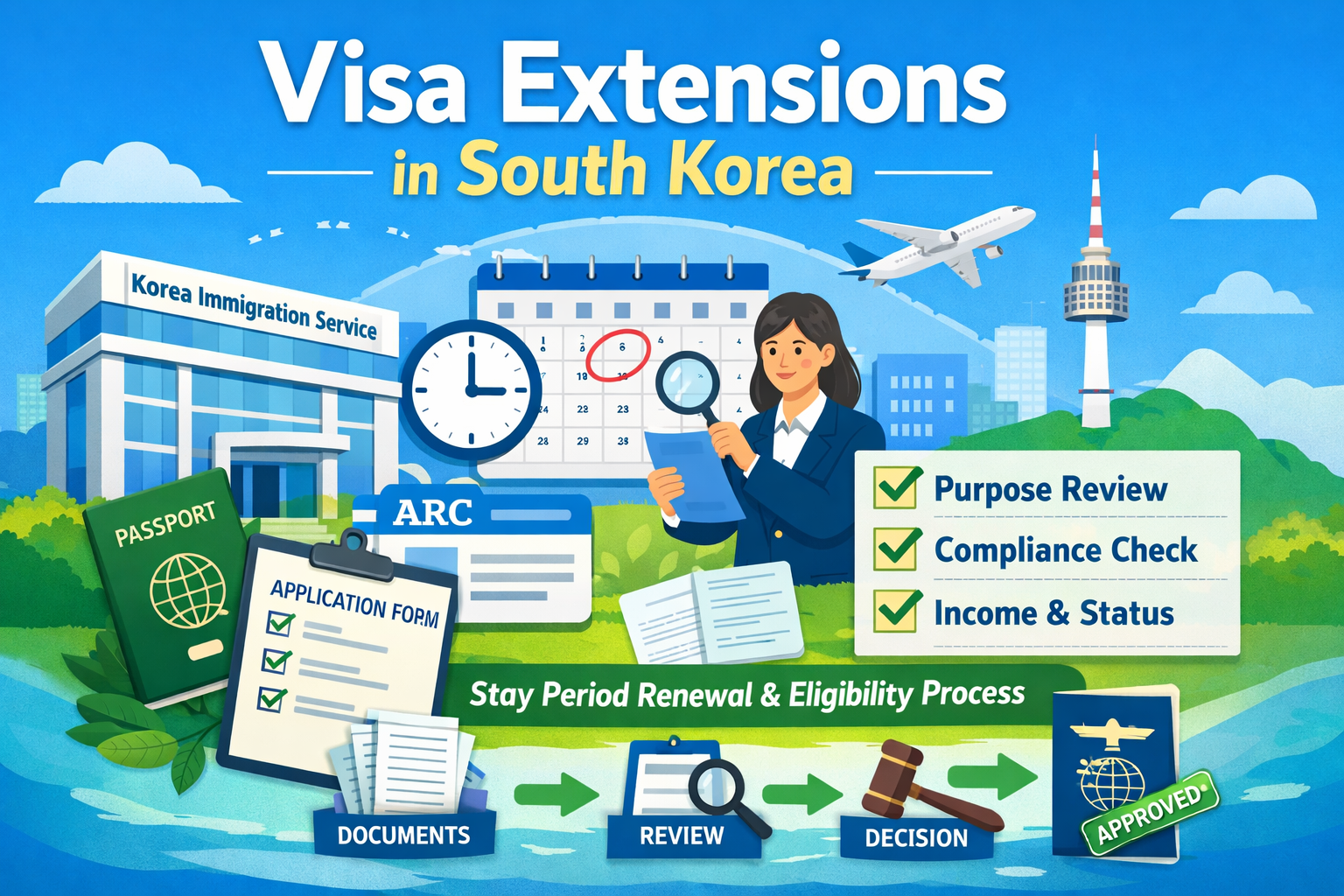
1. Legal Basis and Administrative Structure
Visa extensions in South Korea are governed primarily by the Immigration Control Act (출입국관리법) and related Enforcement Decrees and Regulations. Administration is handled by the Korea Immigration Service (출입국·외국인청) under the Ministry of Justice (법무부).
An extension of stay is not a new visa issuance. Rather, it is an administrative approval that allows a foreign resident to continue staying under the same status, subject to review of ongoing eligibility.
In practice, this means:
- The visa category remains the same
- The stay period is re-examined
- Eligibility conditions are reassessed
- Compliance history is reviewed
The extension process therefore operates as a conditional renewal, not as an automatic right.
2. Extension vs. Change of Status
It is important to distinguish between:
- Extension of Stay (체류기간 연장)
- Change of Status of Stay (체류자격 변경)
An extension maintains the same visa category and seeks additional time.
A change of status involves transitioning from one visa type to another.
For example:
- An E-7 (특정활동) professional worker extending employment duration would apply for an extension.
- A D-2 (유학) student switching to employment would apply for a change of status.
The documentation, review scope, and scrutiny level may differ depending on which procedure is requested.
3. When Should an Extension Be Filed?
Under general administrative practice, an extension application must be submitted before the expiration of the authorized stay period.
In most cases:
- Applications may be filed approximately 4 months before expiration (depending on visa type).
- Filing after expiration may result in overstay penalties.
Even a short overstay can trigger fines, record entries, and potential future disadvantages. Immigration authorities typically evaluate compliance history during extension review.
Therefore, timing is structurally significant.
4. General Eligibility Review Criteria
Although required documents vary by visa type, immigration officers typically review several common elements:
4.1 Continuity of Purpose
The applicant must demonstrate that the original purpose of stay continues.
Examples:
- Employment contract remains valid.
- Academic enrollment is ongoing.
- Marriage relationship remains legally intact.
- Business activity remains active.
If the original basis for residence has materially changed, an extension may not be appropriate.
4.2 Compliance History
Immigration authorities generally review:
- Overstay history
- Unauthorized employment
- Reporting compliance (address changes, workplace changes, etc.)
- Criminal record issues
Administrative compliance can significantly influence extension decisions.
4.3 Financial and Activity Stability
Depending on visa category, immigration may examine:
- Income level
- Tax payment records
- Business performance
- Employer stability
- Academic performance
The review is typically contextual. For example, employment-based visas often involve salary and contract verification, while student visas may focus on attendance and academic standing.

5. Required Documentation: General Patterns
Although specific documents vary by visa category, common documentation may include:
- Application form
- Passport
- Alien Registration Card (외국인등록증)
- Proof of ongoing activity (contract, enrollment certificate, marriage certificate, etc.)
- Tax or income verification (where applicable)
- Fee payment receipt
Additional documentation may be requested depending on the case.
In practice, immigration offices may request supplementary documents even if not explicitly listed in basic guidelines.
6. Review Process and Decision Structure
Visa extension decisions are administrative determinations. The process generally involves:
- Submission (online or in person)
- Document verification
- Substantive eligibility review
- Internal officer assessment
- Decision issuance
Some applications are approved relatively quickly, particularly when documentation is complete and circumstances are stable. Others may require additional review time.
There is typically no guaranteed processing timeline, and approval is not automatic.
7. Online vs. In-Person Applications
In many cases, applications may be submitted via the HiKorea website (하이코리아). However, certain visa categories require in-person visits to the immigration office (출입국·외국인청).
In practice:
- Routine employment extensions may be processed online.
- Family-based or status-sensitive cases may require in-person submission.
- Complex documentation cases may be directed to in-office review.
Whether online submission is permitted depends on visa type and system eligibility.
8. What Happens If an Extension Is Denied?
If an extension application is denied, the applicant may be required to depart Korea before the original stay period ends.
Depending on the circumstances, options may include:
- Filing an administrative appeal
- Reapplying with corrected documentation
- Departing and reapplying from abroad
Outcomes vary depending on the specific legal and factual basis of the denial.
9. Common Structural Issues in Extension Cases
Certain patterns frequently affect extension outcomes:
9.1 Mismatch Between Actual Activity and Visa Type
If the applicant's real-world activity differs from the registered visa purpose, immigration may question eligibility.
9.2 Late Reporting of Changes
Foreign residents are generally required to report:
- Change of address
- Change of employer
- Change of marital status
Failure to report may affect extension approval.
9.3 Income Below Required Threshold
Certain visas contain minimum income standards or financial viability expectations.
9.4 Gaps in Activity
Periods of inactivity (e.g., job gaps, enrollment gaps) may require explanation.
10. Processing Period and Stay During Review
If an extension is filed before expiration, the applicant may generally remain in Korea while the application is pending, even if the original expiration date passes during processing.
However, travel outside Korea during pending review may not always be permitted without prior confirmation.
11. Special Considerations by Visa Type
Although this article explains general principles, each visa category operates under distinct criteria:
- E-series (Employment) visas often emphasize employer documentation.
- F-series (Residence/Family) visas may involve relationship verification.
- D-series (Study/Training) visas may require academic compliance evidence.
- Business visas may involve tax and operational records.
The extension framework is consistent, but the evidentiary focus differs.
12. Extension Does Not Guarantee Long-Term Stability
It is important to understand that extensions are typically granted for limited additional periods (e.g., 1 year, 2 years), depending on visa type.
Each renewal may involve reassessment. Long-term residence generally requires separate eligibility under permanent residence categories (e.g., F-5 (영주권)).
Frequently Asked Questions (FAQ)
Q1. Can I apply for an extension after my visa has already expired?
In general, applications must be submitted before the authorized stay expires. Late applications may result in overstay penalties and could negatively affect review outcomes.
Q2. Is visa extension automatic if I still have a valid job contract?
Not necessarily. Immigration authorities may review compliance history, income level, reporting obligations, and other factors in addition to the employment contract.
Q3. Can I travel outside Korea while my extension is being reviewed?
This may depend on visa type and processing stage. In practice, leaving Korea during pending review can create complications unless prior confirmation is obtained.
Q4. How long does the extension process usually take?
Processing time varies depending on visa type, workload, and documentation completeness. There is no universally fixed timeline.
Q5. Does a visa extension reset my residence period for permanent residency eligibility?
Generally, extension maintains continuity of stay, but eligibility for permanent residence (F-5 (영주권)) depends on cumulative lawful residence and other criteria defined separately.

Conclusion
Visa extensions in South Korea function as conditional administrative renewals rather than automatic rights. Immigration authorities generally reassess the continuity of purpose, compliance history, and financial or activity stability before approving additional stay periods.
Understanding the structural logic of the extension process — timing, documentation, review standards, and administrative discretion — can help foreign residents better anticipate how their stay status may be evaluated.
Each visa category operates within the same overarching framework but applies distinct evidentiary standards.


