Introduction
Alien Registration is a fundamental administrative requirement for most foreign nationals who intend to stay in Korea beyond a short period. While the concept may appear straightforward, confusion often arises due to differences between short-term and long-term stays, visa categories, and the practical steps involved in registration.
This guide explains, in a neutral and informational manner, how alien registration generally works in Korea, why it exists, who must complete it, and how it is typically handled in practice. The purpose is to help foreign residents understand the structure of the system rather than to provide case-specific guidance.
1. What Is Alien Registration?
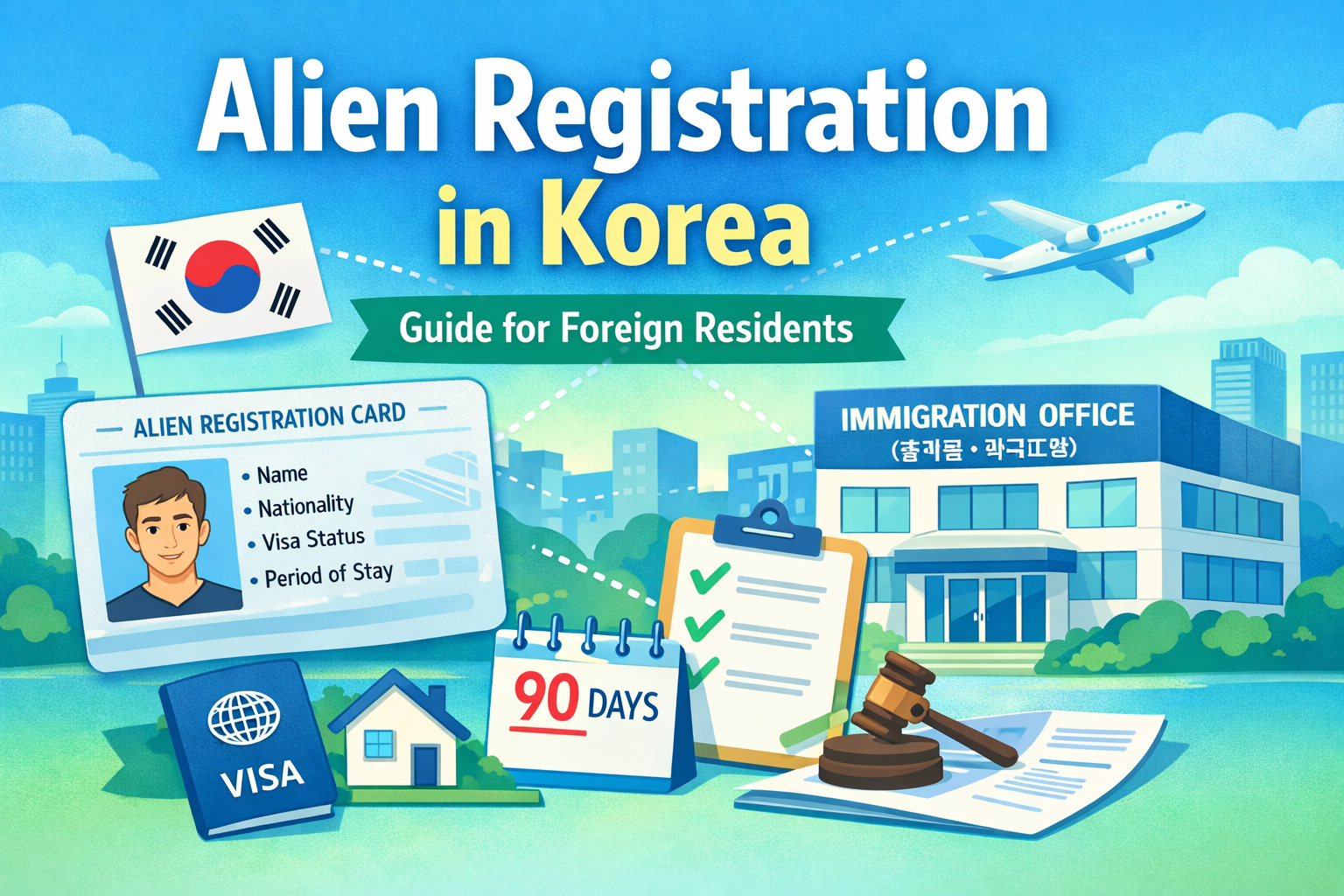
Alien Registration refers to the process by which certain foreign nationals formally register their residence and status with the Korean immigration authorities. Once registration is completed, the individual is issued an Alien Registration Card (ARC) (외국인등록증), which serves as an official identification document during their stay in Korea.
In practice, the ARC functions similarly to a national ID card for foreign residents. It confirms the holder’s identity, visa status, and period of authorized stay.
2. Legal Purpose of Alien Registration
Alien registration exists to allow the government to manage and administer the stay of foreign nationals in a structured way. From an administrative perspective, it helps authorities:
- Confirm the identity and residence of foreign nationals
- Track the length and conditions of stay
- Link immigration status with other public systems (such as residence reporting)
For foreign residents, registration provides a formal legal identity within Korea’s administrative system, enabling access to various everyday procedures.
3. Who Is Required to Register?
3.1 Long-Term Stay Holders
In general, foreign nationals who stay in Korea for more than 90 days are required to apply for alien registration. This applies regardless of nationality, unless a specific exemption exists.
Typical visa categories that require registration include long-term residence, work, study, and family-related visas.
3.2 Short-Term Visitors
Foreign nationals staying 90 days or less under short-term visas or visa-free entry are generally not required to register. However, if a short-term status changes to a long-term one while in Korea, registration becomes necessary.
3.3 Special Cases
Depending on circumstances, certain individuals (such as diplomats or those under specific international agreements) may follow different procedures. These cases are handled under separate administrative rules.
4. When Must Alien Registration Be Completed?
Alien registration must usually be completed within 90 days of entry into Korea for those who are required to register.
In practice, the registration date is calculated from the date of arrival recorded at entry. Delays beyond the required period may result in administrative consequences, depending on circumstances.
5. Where Is Alien Registration Processed?
Alien registration is handled by the immigration office (출입국·외국인청) that has jurisdiction over the applicant’s place of residence.
Korea has multiple regional immigration offices, and applicants are generally required to visit the office that corresponds to their registered address. Applications submitted to an incorrect office may be redirected.
6. Documents Commonly Required
While exact requirements may vary by visa type and individual situation, the following documents are generally requested during alien registration:
- A valid passport
- A completed application form
- One or more identification photographs
- Proof of residence (such as a housing contract or confirmation document)
- Documents related to the specific visa category
Additional documents may be required depending on the nature of stay, employment, or family relationship.
7. The Alien Registration Card (ARC)
7.1 What the ARC Represents
The Alien Registration Card is an official physical card issued after successful registration. It includes information such as:
- Name
- Date of birth
- Nationality
- Visa status
- Period of stay
- Registered address
The ARC is commonly used as proof of identity in daily life.
7.2 Practical Uses of the ARC
In practice, the ARC is often required for:
- Opening bank accounts
- Signing long-term contracts
- Registering mobile phone services
- Accessing certain public or private services
Because of this, receiving the ARC is often considered a key step in settling into life in Korea.
8. Processing Time and Collection
Processing times vary depending on workload and location. Generally, the ARC is not issued on the same day as the application.
In practice, applicants may receive:
- A confirmation document while waiting
- Notification when the ARC is ready for collection
- Delivery by mail in some cases
The waiting period may range from several weeks to longer, depending on circumstances.
9. Address Reporting Obligations
After alien registration, foreign residents are generally required to report any change of address within a specified period.
This obligation applies when:
- Moving to a new residence
- Changing housing within the same jurisdiction
- Relocating to a different region
Address reporting is considered part of maintaining accurate registration information.
10. Changes to Status After Registration
Alien registration does not remain static. In practice, changes may occur due to:
- Visa extensions
- Changes in visa category
- Employment changes
- Family status changes
When such changes occur, updates to registration information may be required through the immigration office.
11. Expiration and Renewal Considerations
The ARC is generally valid only for the period of authorized stay. When a visa is extended or renewed, the registration record is updated accordingly.
If the period of stay expires without renewal, the registration status may also become invalid. Managing expiration dates is therefore an important administrative responsibility for foreign residents.
12. Loss or Damage of the ARC
If an ARC is lost or damaged, replacement procedures are available. In practice, this involves:
- Reporting the loss
- Submitting an application for reissuance
- Providing identification and supporting documents
Replacement procedures follow administrative rules similar to the initial issuance process.
13. Why Alien Registration Matters in Daily Life
Although alien registration is a legal requirement, its importance is often felt most strongly in everyday situations. Many systems in Korea assume the existence of a resident registration number, and the ARC fulfills that role for foreign nationals.
Without registration, access to certain services may be limited or delayed.
14. Common Misunderstandings
Some common misunderstandings include:
- Assuming short-term visitors must register
- Believing registration is optional for long-term stays
- Confusing visa issuance with alien registration
In practice, visa status and alien registration are related but separate administrative concepts.

FAQ
Q1. Is alien registration the same as getting a visa?
No. A visa determines entry and stay conditions, while alien registration is a domestic administrative process completed after entry for eligible foreign nationals.
Q2. Can I apply for alien registration immediately after arriving in Korea?
Generally, yes. In practice, applications are often submitted after securing a local address, as proof of residence is usually required.
Q3. Do I need to carry my ARC at all times?
In practice, the ARC serves as an official ID, and carrying it is commonly recommended for identification purposes.
Q4. What happens if I miss the registration deadline?
Consequences depend on circumstances. In general, late registration may result in administrative penalties, depending on the situation.
Q5. Does alien registration apply to all nationalities equally?
The general framework applies broadly, but specific exemptions or special rules may exist depending on nationality or visa category.
Conclusion
Alien registration is a core part of the Korean immigration system for foreign residents staying beyond a short-term period. While procedures and requirements may vary in detail, the overall structure remains consistent: eligible foreign nationals register their stay, receive an ARC, and maintain updated information throughout their residence in Korea.
Understanding this framework helps foreign residents navigate daily life and administrative processes with greater clarity and fewer surprises.


