1. Introduction
Foreign nationals entering the Republic of Korea are classified under the immigration system primarily based on the purpose and duration of stay. From an administrative perspective, the Korean immigration framework broadly distinguishes between short-term stay and long-term stay, with each category governed by different legal bases, procedures, rights, and obligations.
This distinction is not merely descriptive. In practice, it determines whether a foreign national may engage in certain activities, whether registration is required, how extensions or changes are handled, and how compliance is monitored.
This article explains, in a structured and neutral manner, how short-term stay and long-term stay are generally defined and administered under Korean immigration law. It focuses on system design and operational logic, rather than on individual visa strategies or case-specific advice.
2. Legal Framework of Stay Classification
The Korean immigration system is administered under the Immigration Control Act (출입국관리법) and its subordinate regulations. The system is managed by the Ministry of Justice, through local immigration offices.
From a legal standpoint, the concept of “stay” is determined by two core elements:
- Permitted period of stay
- Permitted scope of activities
Based on these elements, stay statuses are grouped into short-term and long-term categories.
3. What Is a Short-Term Stay?
3.1 General Definition
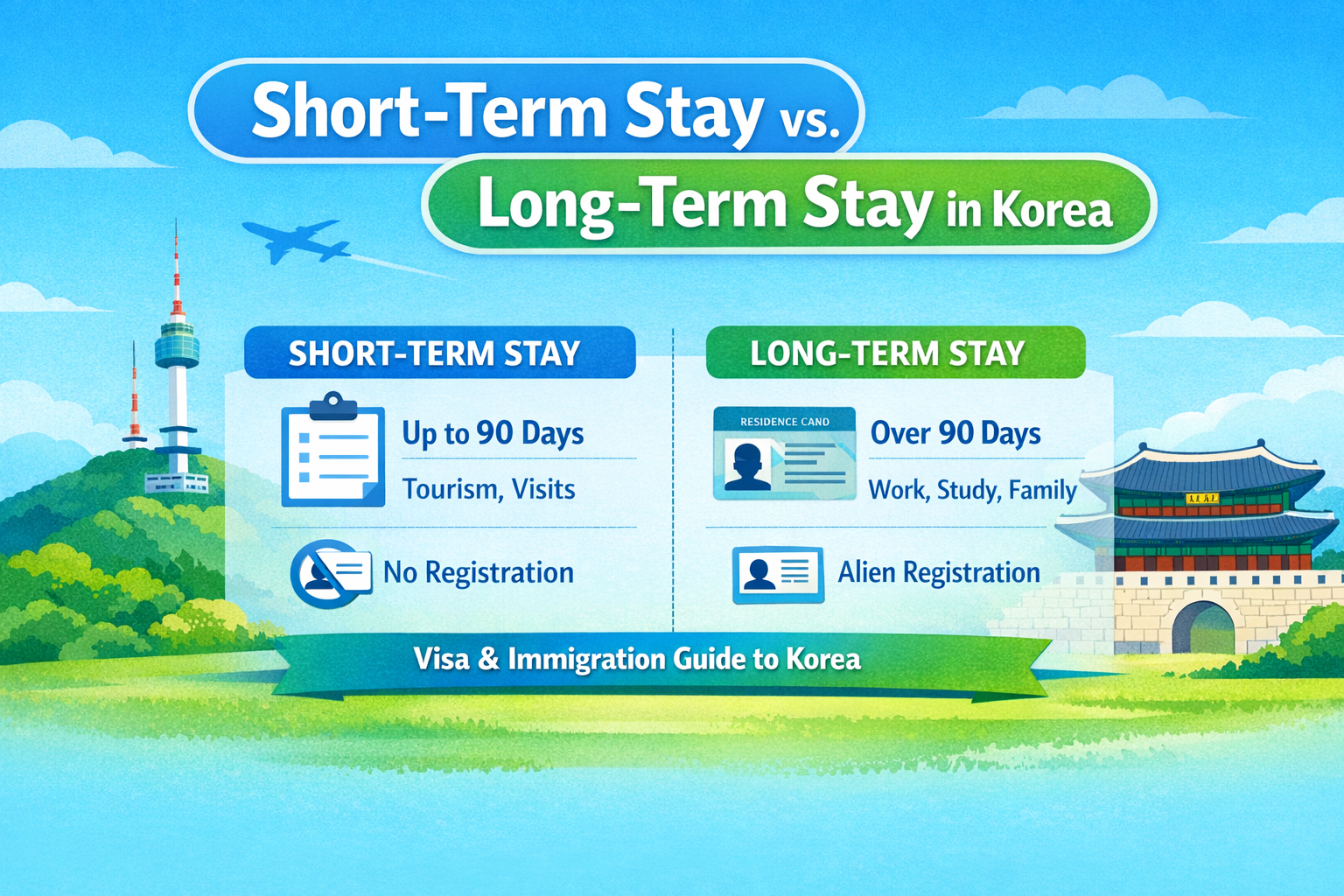
A short-term stay generally refers to a stay with a limited duration, typically 90 days or less, where the foreign national is not integrated into the resident administrative system of Korea.
Short-term stay statuses are designed for temporary presence rather than settlement or ongoing participation in Korean society.
3.2 Typical Purposes of Short-Term Stay
In practice, short-term stay is commonly used for:
- Tourism and leisure
- Visiting family or acquaintances
- Attending conferences or business meetings
- Market research or short-term commercial activities
- Transit through Korea
These activities are non-continuous and non-remunerative within Korea.
3.3 Common Short-Term Stay Statuses
Examples of short-term stay classifications include:
- Short-Term Visit (C-3 단기방문)
- Visa-free entry (무사증입국), depending on nationality
- Transit Stay (B-2 통과)
While these categories differ in detail, they share the same structural characteristics.
3.4 Administrative Characteristics
Short-term stay generally involves:
- No Alien Registration Card issuance
- No resident registration equivalent
- Limited or no extension options
- Strict prohibition on employment or profit-generating activities
The immigration authority primarily evaluates entry eligibility at the border, with limited post-entry administration.
4. What Is a Long-Term Stay?
4.1 General Definition
A long-term stay refers to a stay exceeding 90 days, where the foreign national is recognized as a resident under immigration administration and is subject to continuous oversight.
Long-term stay is designed for structured, ongoing purposes, such as employment, study, family residence, or long-term projects.
4.2 Typical Purposes of Long-Term Stay
Long-term stay statuses generally cover:
- Employment or professional activities
- Academic study or research
- Marriage or family-based residence
- Investment or corporate management
- Cultural, religious, or journalistic activities
These purposes assume continuity and stability rather than temporary presence.
4.3 Common Long-Term Stay Statuses
Examples include:
- Employment-based statuses (E-series 취업)
- Study and research statuses (D-series 체류자격)
- Family-based statuses (F-series 가족·거주)
Each status has its own eligibility criteria, documentation requirements, and activity scope.
4.4 Administrative Characteristics
Long-term stay generally requires:
- Alien registration (외국인등록)
- Issuance of a residence card
- Registered address in Korea
- Periodic reporting of changes (address, employer, marital status)
- Extensions or renewals through formal applications
In contrast to short-term stay, post-entry compliance becomes a core element.
5. Key Structural Differences Between Short-Term and Long-Term Stay
5.1 Duration and Stability
| Typical Duration | Up to 90 days | Over 90 days |
| Nature of Stay | Temporary | Continuous |
| Settlement Assumption | No | Yes |
The system assumes fundamentally different levels of social and administrative integration.
5.2 Registration and Identification
- Short-term stay: No formal resident identification system applies.
- Long-term stay: Alien registration creates a legal identity within Korean administration, similar in function (though not identical) to resident registration for citizens.
5.3 Scope of Activities
Short-term stay activities are:
- Narrowly defined
- Purpose-specific
- Closely tied to the stated reason for entry
Long-term stay activities are:
- Categorized by stay status
- Monitored over time
- Subject to change-of-status or amendment procedures
5.4 Employment and Income
As a general rule:
- Short-term stay: Employment is prohibited.
- Long-term stay: Employment may be allowed only if explicitly permitted under the specific stay status.
Unauthorized activities are treated as status violations, regardless of intent.
6. Extensions and Changes of Stay
6.1 Extension of Stay
- Short-term stay extensions are exceptional and limited.
- Long-term stay extensions are institutionalized and expected, subject to compliance.
Extensions are not automatic; they depend on continued fulfillment of status requirements.
6.2 Change of Stay Status
Changing from short-term to long-term stay is procedurally possible in some circumstances, but it is not guaranteed.
In practice, authorities evaluate:
- Whether the new purpose existed at entry
- Whether the applicant maintained lawful stay
- Whether the change aligns with immigration policy
The system emphasizes predictability and consistency, rather than convenience.
7. Compliance and Monitoring Logic
7.1 Short-Term Stay Monitoring
Monitoring focuses on:
- Entry screening
- Exit confirmation
- Overstay detection
Post-entry supervision is minimal.
7.2 Long-Term Stay Monitoring
Long-term stay involves:
- Ongoing status management
- Periodic reporting obligations
- Administrative penalties for non-compliance
The longer the stay, the greater the emphasis on procedural accuracy.
8. Practical Implications of the Distinction
Understanding whether a stay is classified as short-term or long-term affects:
- What activities are lawful
- Whether registration is required
- How flexible future immigration options may be
- How strictly compliance is enforced
In practice, many misunderstandings arise from assuming that short-term presence can gradually evolve into long-term residence without formal procedures, which is generally not how the system operates.

9. Frequently Asked Questions (FAQ)
Q1. Is a short-term stay simply a “tourist visa”?
Not necessarily. While tourism is a common purpose, short-term stay includes various non-tourism activities, such as business meetings or family visits, provided they remain temporary and non-remunerative.
Q2. Does staying less than 90 days always mean short-term stay?
Generally yes, but the authorized period and status designation, not just the number of days, determine the classification.
Q3. Can a short-term stay holder work remotely for a foreign company?
The immigration system evaluates activities conducted within Korea, not just the source of income. In practice, this area can involve interpretive complexity depending on circumstances.
Q4. Why is alien registration required for long-term stay?
Registration allows immigration authorities to identify, manage, and monitor residents over time. It is a structural requirement for long-term residence administration.
Q5. Is long-term stay permanent residence?
No. Long-term stay refers to extended residence under a specific status, not permanent residence. Permanent residence is a separate legal classification.
10. Conclusion
The distinction between short-term stay and long-term stay is a foundational element of the Korean immigration system. It reflects different assumptions about duration, purpose, integration, and administrative responsibility.
Understanding this structural divide helps foreign nationals interpret immigration rules more accurately and reduces confusion about what is permitted at each stage of stay. Ultimately, the system is designed not around individual convenience, but around clarity of purpose and administrative order.
'✈️ VISA in Korea (출입국·체류 제도)' 카테고리의 다른 글
| What Is Alien Registration in Korea? ARC Explained for Long-Term Stayers (0) | 2026.03.30 |
|---|---|
| Common Documents Required for Korean Visa Applications (0) | 2026.03.23 |
| Understanding the Korean Visa System: An Overview (0) | 2026.03.09 |
| How to Report Changes in Your Alien Registration Information in Korea (0) | 2026.03.02 |
| Re-entry Permit and Immigration Permission Guide (1) | 2026.02.23 |


