One of the most misunderstood aspects of living in South Korea as a foreign national is the relationship between your visa status and what you are legally permitted to do — whether that means working, running a business, studying, or simply staying for an extended period.
Korea's immigration framework, governed primarily by the Immigration Act (출입국관리법) and enforced by the Korea Immigration Service (출입국·외국인청), operates on the principle that each status of sojourn (체류자격) comes with a defined scope of activity. Exceeding that scope — even unintentionally — can result in status violations, fines, deportation, or future entry bans.
This post provides a general overview of how activity permissions are structured by visa type in Korea, with a focus on the distinctions that matter most in everyday life.
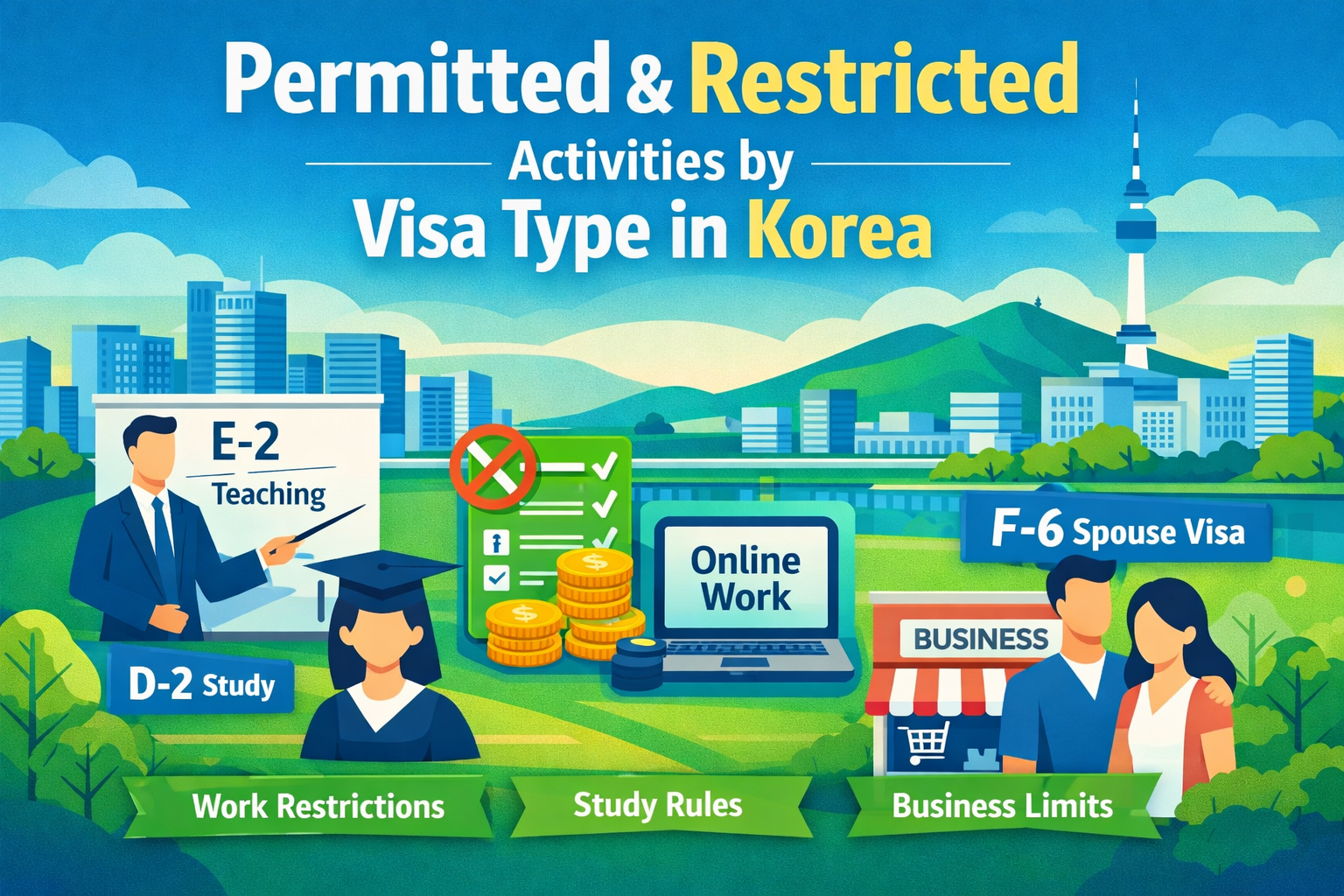
How Korea's Visa System Works: Status of Sojourn, Not Just "Visa"
It is important to distinguish between a visa and a status of sojourn. A visa is the entry permit issued by a Korean consulate abroad. The status of sojourn — assigned upon entry or through an in-country application — determines what you can legally do while in Korea.
All statuses of sojourn are listed in the Enforcement Decree of the Immigration Act (출입국관리법 시행령), Appendix 1, and each carries specific conditions regarding:
- Whether employment is permitted
- Whether side income or freelance work is allowed
- Whether business registration is possible
- Whether study is permitted alongside the primary status
- How long the holder may remain per entry or per year
When in doubt about your specific situation, the HiKorea portal (하이코리아) and the local immigration office (출입국·외국인사무소) are the official reference points.
Major Visa Categories and Their Activity Scope
1. Short-Term Visit Visas (C-Series)
Visas in the C-series — including C-3 (Short-Term General, 단기종합) — are among the most commonly issued and among the most restricted in terms of permitted activities.
Generally permitted:
- Tourism, sightseeing, transit
- Visiting family or friends
- Attending conferences or short-term meetings (non-compensated)
- Medical treatment
Generally not permitted:
- Any form of employment or compensated work
- Long-term study
- Business registration or commercial operations
C-3 holders may remain in Korea for up to 90 days per visit in most cases, depending on bilateral agreements between Korea and the holder's home country. Extensions are generally not available from within Korea for this status.
2. Employment-Based Visas (E-Series)
The E-series covers most forms of legal employment in Korea. Each sub-category is tied to a specific type of work, and working outside the designated occupation or employer is generally not permitted without prior approval.
| E-1 | University-level teaching | Must be at a designated educational institution |
| E-2 | Foreign language instruction | Employer-specific; private tutoring outside contract generally prohibited |
| E-3 | Research | Institution-specific |
| E-4 | Technology transfer | Field-specific |
| E-5 | Professional services (법률, 의료 등) | License recognition required |
| E-6 | Arts, entertainment, athletics | Venue and activity-specific |
| E-7 | Designated activities | Occupation and employer-specific; change requires re-approval |
| E-9 | Non-professional employment | Employer-specific; job changes require immigration office involvement |
| E-10 | Vessel crew | Activity-specific |
A key practical point: E-2 and E-9 holders, in particular, are restricted to the specific employer and workplace listed on their registration. Working additional hours elsewhere — even for extra income — is treated as unauthorized employment (불법취업) unless a part-time activity permit (시간제취업허가) has been obtained.
3. Student Visas (D-2, D-4)
D-2 (Study, 유학) and D-4 (General Training, 일반연수) are the primary statuses for foreign students in Korea.
Regarding part-time work:
D-2 holders are generally permitted to engage in part-time employment (시간제취업) within defined hour limits — typically up to 20 hours per week during the semester, with expanded hours permitted during vacation periods. This requires a separate part-time activity permit issued by the immigration office.
D-4 holders are generally more restricted. Part-time work is not automatically permitted and is subject to conditions that vary depending on the institution type and the specific language or training program.
Business registration is not permitted under student statuses in most circumstances.
4. Long-Term Residency and Family-Based Statuses
F-series visas generally carry broader activity permissions and are among the most flexible statuses available to foreign nationals.
- F-2 (Residency, 거주): Holders are generally permitted to engage in most forms of employment and, in many cases, business registration, depending on the specific sub-category.
- F-4 (Overseas Korean, 재외동포): Ethnic Koreans with foreign nationality may engage in most lawful employment and commercial activities, with some exceptions in specific regulated sectors.
- F-5 (Permanent Residency, 영주): Holders are generally not restricted in terms of employment type or business registration, making this one of the most unrestricted non-citizenship statuses.
- F-6 (Marriage Migrant, 결혼이민): Generally permitted to work and register businesses, though status maintenance requires ongoing attention to the marriage relationship and reporting obligations.
5. Investment and Business Statuses (D-8, D-9)
Foreign nationals seeking to run a business in Korea typically apply under D-8 (Corporate Investment, 기업투자) or, in some cases, D-9 (Trade Management, 무역경영).
These statuses require prior business registration (사업자등록), a minimum investment threshold, and — for D-8 — an incorporated entity (법인). Employment outside the registered business purpose is generally not permitted.
6. Working Holiday (H-1)
The H-1 (Working Holiday, 워킹홀리데이) status is available to nationals of countries with bilateral working holiday agreements with Korea. Holders may generally work for any employer and in most industries, with some restrictions on specific types of work. This status is typically limited to a single stay of up to one year and is not renewable.
Activity Change and Dual-Status Issues
A common area of confusion involves holding one status while seeking to do something that falls under a different status. Examples include:
- A D-2 student who begins remote freelance work for a foreign company
- An E-7 worker who starts a small personal business on the side
- A C-3 visitor who attends unpaid but ongoing training at a Korean company
In each of these cases, whether the additional activity is permissible depends on the specific circumstances, the nature and compensation of the activity, and, in many cases, whether prior approval was obtained from the immigration office.
Status of sojourn changes (체류자격 변경) must be processed through the Korea Immigration Service before beginning the new activity, not after.
FAQ
Q1. Can I do freelance or remote work for a foreign company while on a tourist visa (C-3)? Generally, compensated work — including remote work paid by a foreign employer — is not considered permissible activity under a short-term tourist status in Korea. The source of the payment does not automatically determine legality; the nature and location of the work activity are also factors evaluated by immigration authorities.
Q2. My status is E-7. Can I register a personal business (개인사업자) separately? In most cases, E-7 holders are not permitted to engage in activities outside the scope of their designated occupation and employer without prior immigration approval. Business registration as a sole proprietor in an unrelated field is generally not permissible under this status without a status change or additional permit.
Q3. I hold an F-4 visa. Are there any employment restrictions I should be aware of F-4 holders generally enjoy broad employment rights, but certain positions — particularly in the public sector or in roles requiring security clearance — may have additional requirements. Some regulated professional activities may also require domestic license recognition (자격 인정) regardless of visa status.
Q4. Can a D-2 student apply for business registration to sell handmade goods online? Business registration for commercial purposes is generally not within the permitted scope of a D-2 student status. Even small-scale online sales activity, if systematic and for profit, may be treated as an activity requiring a different status of sojourn.
Q5. What happens if I exceed the permitted scope of my visa? Violations of the activity scope under the Immigration Act can result in fines, mandatory departure orders, deportation, and in some cases, multi-year re-entry bans. The severity depends on the nature and duration of the violation. It is generally advisable to confirm the permissibility of any planned activity with the relevant immigration office before proceeding.

Summary
Korea's immigration framework is specific and category-driven. Each status of sojourn defines a scope of permitted activity, and moving outside that scope — for work, business, study, or other purposes — generally requires formal approval or a status change.
Foreign residents who are uncertain about whether a planned activity falls within their permitted scope are encouraged to consult the HiKorea portal (www.hikorea.go.kr) or contact their regional immigration office (출입국·외국인사무소) directly for official guidance.
This post is for general informational purposes only and does not constitute legal advice. Immigration regulations are subject to change, and individual circumstances may affect applicable rules.


