Individual vs. Corporate Asset Structures in Korea
Understanding the Framework of Taxation, Ownership, and Legal Form
Introduction
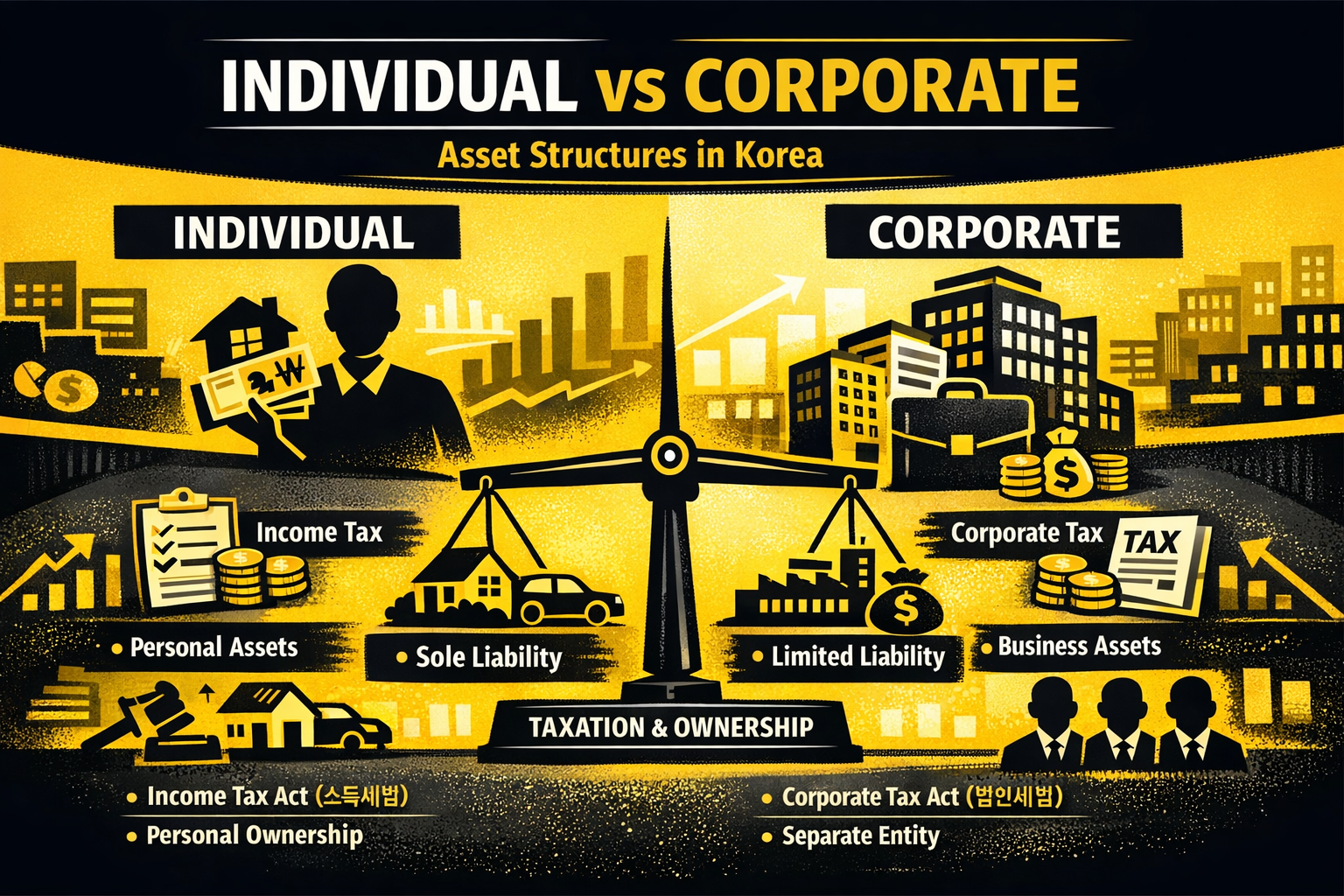
In Korea, assets may be owned and managed either by individuals or through corporate entities. These two structures are governed by distinct legal, tax, and accounting systems. Importantly, the Korean system does not treat “individual” and “corporate” ownership as interchangeable forms; instead, each is designed with different assumptions regarding economic activity, responsibility, and public accountability.
This article provides a structural overview of how individual and corporate asset systems are organized in Korea. It does not aim to evaluate which structure is preferable, nor does it suggest how assets should be arranged. Rather, it explains how the systems are built, how they differ institutionally, and how taxation and reporting obligations are generally framed.
All explanations are descriptive and conditional, based on publicly known (제도) frameworks such as the Income Tax Act (소득세법), Corporate Tax Act (법인세법), and related administrative systems.
1. Legal Identity: Who Owns the Assets?
1.1 Individual Ownership
Under Korean law, an individual (자연인) owns assets directly in their own name. Property rights, income recognition, and tax obligations are attributed to the same legal person.
Key characteristics include:
- Assets and liabilities are not legally separated
- Income is generally attributed on a realization basis
- Responsibility is unlimited (within civil law boundaries)
From a system perspective, individual ownership is treated as unitary: the person, the taxpayer, and the asset holder are the same entity.
1.2 Corporate Ownership
A corporation (법인) is a legally separate entity established under the Commercial Act or special statutes. Once incorporated, the corporation itself becomes the owner of assets, not the shareholders.
Structural implications include:
- Legal separation between the corporation and shareholders
- Independent accounting and tax identity
- Assets are owned “by the entity,” not by individuals behind it
This separation is foundational. Korean law consistently treats corporations as independent subjects of rights and obligations, even when ownership is concentrated.
2. Taxation Framework: How Income Is Classified
2.1 Individual Taxation Structure
Individuals in Korea are taxed under the progressive income tax system.
Income is categorized into statutory classes, such as:
- Earned income (근로소득)
- Business income (사업소득)
- Capital gains (양도소득)
- Interest and dividends (이자·배당소득)
Each category follows its own calculation and recognition rules, but they ultimately aggregate into comprehensive income (종합소득) in many cases.
Important structural features:
- Progressive tax rates apply
- Certain income types are taxed separately by design
- The tax system assumes personal consumption and livelihood as the baseline context
2.2 Corporate Taxation Structure
Corporations are taxed under the Corporate Tax Act (법인세법), which is conceptually different from individual income taxation.
Key structural elements include:
- Taxation based on net income derived from accounting profit, with statutory adjustments
- Flat or tiered corporate tax rates, not progressive by personal status
- Clear distinction between corporate income and shareholder income
Notably, profits are taxed at the corporate level before any distribution occurs. Shareholders are taxed only when profits are distributed (e.g., dividends) or realized through transactions.
3. Accounting Logic: Cash Flow vs. Accrual
3.1 Individuals and Simplified Recognition
For individuals, especially non-corporate business operators, taxation often aligns more closely with cash-based or simplified accounting principles, although this may vary depending on income scale and activity type.
System assumptions include:
- Income reflects personal economic capacity
- Expense recognition focuses on necessity and relevance
- Recordkeeping obligations are comparatively lighter
The structure prioritizes administrative practicality over precision.
3.2 Corporations and Accrual-Based Accounting
Corporations are generally required to follow accrual accounting (발생주의).
This means:
- Income and expenses are recognized when earned or incurred
- Depreciation, provisions, and reserves are systemically regulated
- Financial statements form the basis of taxation
The corporate tax system is therefore tightly linked to accounting standards, reflecting the assumption that corporations are ongoing economic units, not extensions of personal life.

4. Asset Holding and Transfer
4.1 Individuals: Direct Ownership and Transfer
Assets owned by individuals—such as real estate or securities—are generally taxed upon transfer or realization.
Structural characteristics include:
- Capital gains taxation triggered by sale or disposal
- Holding period and asset type affect tax treatment
- Ownership history is directly traceable to the person
The system treats asset appreciation as latent until a taxable event occurs.
4.2 Corporations: Internal Assets and External Transactions
For corporations, assets are components of the balance sheet.
Key differences:
- Asset revaluation is generally limited or regulated
- Gains may be recognized through accounting events, not only sales
- Transfers between corporation and shareholder are strictly scrutinized
From a system perspective, corporate assets are considered part of an institutional pool, not personal wealth.
5. Distribution of Value: When Money Leaves the Entity
5.1 Individuals: Income Equals Use
For individuals, income and use are often simultaneous. Once income is recognized, it is generally free for personal use, subject only to taxation.
There is no formal “distribution” concept; income is already personal.
5.2 Corporations: Distribution as a Legal Event
In corporations, value leaving the entity is structurally significant.
Common forms include:
- Dividends (배당)
- Compensation to executives or employees
- Transactions with related parties
Each form has distinct tax and legal implications. Importantly, distributions are secondary events, occurring after corporate income has already been determined.
6. Reporting and Compliance Philosophy
6.1 Individuals: Declarative Compliance
The individual tax system relies heavily on self-reporting and post-verification.
Structural assumptions:
- Lower transaction complexity
- Limited external stakeholders
- Focus on tax collection efficiency
Administrative systems are designed for scale and accessibility.
6.2 Corporations: Institutional Transparency
Corporations operate under a higher transparency threshold.
Features include:
- Mandatory bookkeeping and documentation
- External audits in certain cases
- Greater exposure to regulatory review
This reflects the view that corporations affect not only owners, but also employees, creditors, and markets.
7. Risk and Responsibility Allocation
7.1 Individuals
- Legal and financial responsibility is unified
- Risks are borne personally
- Tax obligations are inseparable from the person
7.2 Corporations
- Liability is structurally limited to the entity
- Responsibility is distributed across legal roles
- Compliance failures may trigger layered consequences
This separation is one of the defining structural features of corporate systems.

Conclusion: Two Parallel Systems, Not a Spectrum
In Korea, individual and corporate asset structures are not merely different “options” along a single continuum. They are parallel systems, each built on different assumptions:
- Individuals are viewed as living economic units, where income, consumption, and responsibility converge
- Corporations are treated as institutional actors, requiring separation, formality, and accountability
Understanding these systems structurally—rather than strategically—helps clarify why rules differ, why transitions are regulated, and why taxation outcomes cannot be evaluated without reference to the underlying legal form.


