1. Introduction: Why Income Classification Matters
In the Korean tax system, income is not treated as a single, uniform concept. Instead, it is classified into legally defined categories, each governed by different calculation rules, reporting methods, and tax treatments. This classification framework plays a foundational role in determining how income is assessed, aggregated, or separated for taxation purposes.
Understanding the types of taxable income in Korea does not require familiarity with tax planning or strategy. Rather, it requires an appreciation of how the system itself is structured and why lawmakers distinguish one type of income from another. This article provides a descriptive and analytical overview of those income categories as defined under Korean tax law.
All references are informational and explanatory, focusing on structure rather than outcomes.
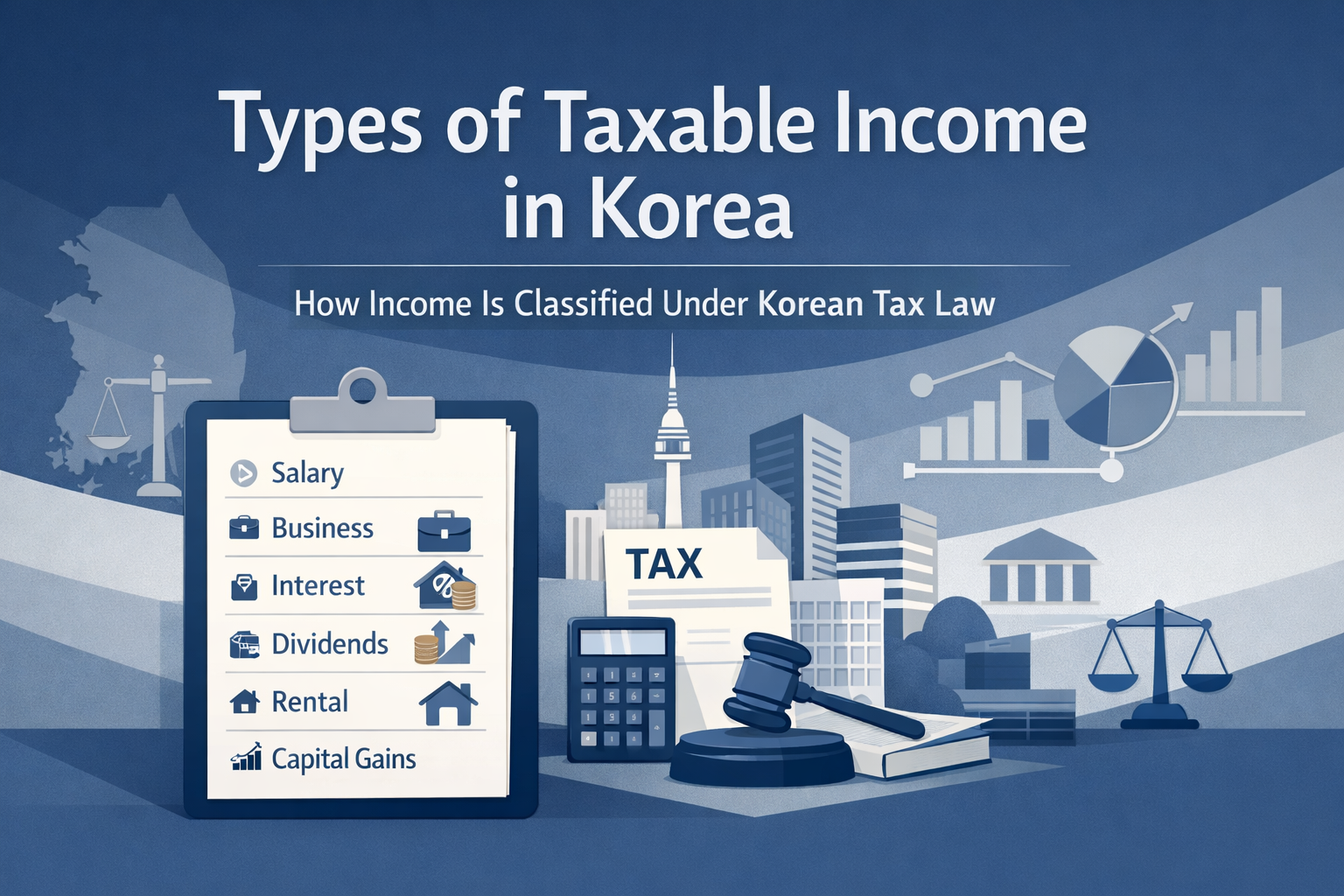
2. Legal Basis of Income Classification in Korea
The primary legal framework governing income taxation in Korea is the Income Tax Act (소득세법). Under this statute, taxable income is broadly divided into several distinct categories, each reflecting the nature of how income is generated.
At a structural level, Korean tax law distinguishes income based on:
- Source (labor, capital, business activity, transfer of assets, etc.)
- Continuity (recurring vs. non-recurring)
- Connection to personal activity or property
- Domestic or foreign origin, depending on residency status
Administration and interpretation of these categories are overseen by the National Tax Service, which issues guidance and enforces compliance based on statutory definitions.
3. Employment Income (근로소득)
3.1 Conceptual Definition
Employment income refers to compensation received in exchange for labor or services provided under an employment relationship. This category is characterized by a degree of subordination, continuity, and contractual obligation between payer and recipient.
3.2 Typical Components
Employment income may include:
- Salaries and wages
- Bonuses and performance-based compensation
- Allowances and certain benefits provided by employers
From a structural standpoint, employment income is generally withheld at source, meaning taxes are deducted by the employer before payment to the employee. This reflects the system’s emphasis on administrative efficiency and predictability.
4. Business Income (사업소득)
4.1 Structural Characteristics
Business income arises from independent economic activities conducted continuously and for profit. Unlike employment income, it is not based on an employer-employee relationship but on autonomous business operations.
4.2 Scope of Activities
Business income may be associated with:
- Sole proprietorships
- Professional services
- Commercial or service enterprises
Structurally, business income is subject to self-assessment, meaning the taxpayer calculates and reports income directly. This reflects the decentralized nature of business activities and the variability of income streams.
5. Interest Income (이자소득)
5.1 Nature of Interest Income
Interest income is generated from the use of capital, rather than labor or business activity. It typically arises from financial instruments where capital is lent or deposited.
5.2 Common Sources
Examples include:
- Bank deposits and savings accounts
- Bonds and similar debt instruments
- Certain financial products that yield fixed returns
In the Korean system, interest income is often subject to withholding, but it may also be aggregated with other income depending on thresholds and statutory rules. Structurally, this reflects the system’s attempt to balance simplicity with comprehensive income recognition.
6. Dividend Income (배당소득)
6.1 Structural Definition
Dividend income refers to distributions received by shareholders or investors from corporate profits. It represents a return on equity rather than debt.
6.2 Systemic Features
Dividend income:
- Originates from ownership interests
- Is typically distributed after corporate-level taxation
- May be subject to separate or combined taxation depending on circumstances
From a systems perspective, dividend income highlights the interaction between corporate taxation and individual taxation, though this article does not assess outcomes or efficiency.
7. Rental Income (임대소득)
7.1 Conceptual Framework
Rental income arises from allowing others to use property—typically real estate—in exchange for consideration. It is classified separately due to its connection to asset ownership rather than active business operations.
7.2 Structural Elements
Rental income may include:
- Residential property rent
- Commercial property lease payments
Korean tax law distinguishes rental income based on factors such as:
- Type of property
- Scale and continuity of leasing activity
These distinctions reflect the system’s effort to categorize income according to economic substance.
8. Capital Gains (양도소득)
8.1 Definition and Scope
Capital gains arise from the transfer or disposal of certain assets, such as real estate or securities, where the transfer price exceeds the acquisition price.
8.2 Structural Characteristics
Key features include:
- Taxation at the point of realization (transfer)
- Asset-specific rules and calculation methods
- Separation from recurring income categories
Capital gains are structurally treated as event-based income, recognizing that they are typically non-recurring and asset-dependent.
9. Other Income (기타소득)
9.1 Residual Category
Other income serves as a residual classification for income that does not fall neatly into the main categories. This reflects the system’s need for completeness.
9.2 Examples
Other income may include:
- Prizes and awards
- Temporary or incidental payments
- Certain royalties or compensation not tied to continuous activity
Structurally, this category ensures that atypical income is still recognized within the tax framework.
10. Comprehensive vs. Separate Taxation Structure
Korean tax law employs both:
- Comprehensive taxation, where multiple income types are aggregated, and
- Separate taxation, where certain income is taxed independently
This dual structure reflects policy considerations related to:
- Administrative feasibility
- Income volatility
- Nature and source of income
The distinction is structural and procedural, rather than strategic.
11. Domestic and Foreign-Source Income
Income classification in Korea also considers source location:
- Domestic-source income
- Foreign-source income
Whether and how foreign-source income is included depends on tax residency status, which is determined by objective criteria such as duration of stay and economic ties. This article does not address optimization or cross-border planning.
12. Reporting and Assessment Framework
From a systems perspective, taxable income categories influence:
- Reporting methods (withholding vs. self-reporting)
- Timing of assessment
- Documentation requirements
These procedural differences are designed to align with the nature of income generation, not individual outcomes.

#KoreaTaxSystem #TaxableIncomeKorea #KoreanIncomeTax #KoreaTaxStructure #IncomeClassification #KoreaFinanceLaw #KoreaInvestmentInsight #TaxEducation #KoreaTaxOverview #FinancialLiteracyKorea
13. Conclusion: A System Built on Categorization
The Korean tax system approaches income taxation through clear categorical distinctions rather than a single unified income concept. Employment, business activity, capital use, asset transfers, and incidental receipts are each treated as structurally different phenomena.
Understanding these categories provides insight into:
- How the system interprets economic activity
- Why different income types are treated differently
- How legal definitions shape tax administration
This overview is intended solely to explain how taxable income is classified in Korea, offering a structural foundation for further institutional or legal understanding.
This article is for educational and informational purposes only and does not constitute tax, legal, or investment advice.


