Asset Holding vs. Transaction-Based Taxation in Korea
Understanding the Structural Logic of Korea’s Tax and Asset Framework
Introduction: Why Structure Matters More Than Outcomes
When discussing taxation and asset-related systems in Korea, it is often tempting to focus on numerical outcomes—tax rates, thresholds, or timing effects. However, such an approach can obscure a more important question: how the system itself is designed.
Korea’s tax framework, particularly in relation to assets, is built on a dual-axis structure:
- Asset holding (ownership over time)
- Asset transactions (events of change)
Understanding this distinction is essential for interpreting Korean tax rules correctly. Many apparent inconsistencies or perceived “burdens” in the system become more coherent when viewed through this structural lens.
This article explains the conceptual and institutional logic behind Korea’s asset-related taxation, focusing on structure, classification, and administrative intent, rather than outcomes or optimization.
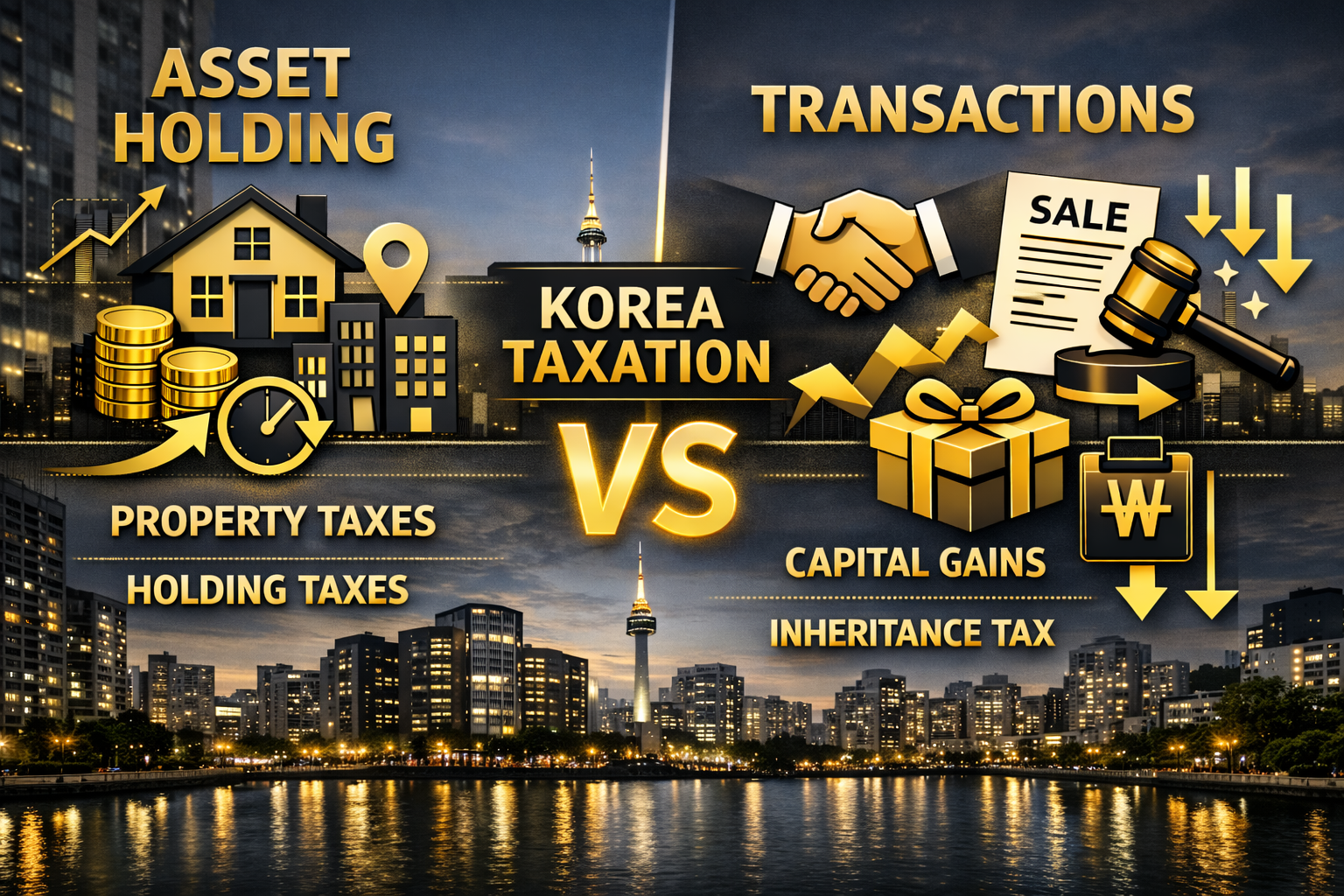
1. The Core Concept: Holding vs. Transaction
At a high level, Korea distinguishes taxation based on whether value is being held or transferred.
1.1 Asset Holding (보유 중심 과세)
Asset-holding taxation applies when a person or entity continues to own an asset over time, regardless of whether income is generated or a transaction occurs.
Key characteristics:
- Periodic (often annual)
- Linked to ownership status
- Independent of realization of profit
Examples (Korean terms used only where necessary):
- Property holding taxes (재산세)
- Comprehensive real estate holding tax (종합부동산세)
- Certain wealth or deemed-value assessments
The conceptual rationale is capacity-based: ownership itself is treated as an indicator of economic capacity, even without cash flow.
1.2 Transaction-Based Taxation (거래 중심 과세)
Transaction-based taxes arise only when a legal or economic event occurs.
Key characteristics:
- Event-triggered
- Requires a legal act (sale, transfer, inheritance, etc.)
- Often involves valuation at a specific point in time
Common categories:
- Capital gains tax (양도소득세)
- Acquisition tax (취득세)
- Inheritance and gift tax (상속세·증여세)
Here, taxation is tied to realization or transfer, not mere possession.
2. Why Korea Emphasizes This Dual Structure
2.1 Administrative Clarity
From an institutional perspective, separating holding and transaction taxation simplifies enforcement:
- Holding taxes rely on registries and status
- Transaction taxes rely on documents and events
Each can be administered through different data sources and legal triggers.
2.2 Policy Neutrality (In Theory)
Structurally, the system aims to avoid taxing the same economic value in the same way twice:
- Holding taxes reflect ongoing economic presence
- Transaction taxes reflect changes in control or realization
Although overlap may appear in practice, the legal logic treats these as distinct dimensions.
3. Asset Classification as the Foundation
Korea’s tax system relies heavily on asset classification, often more than on taxpayer intent.
3.1 Major Asset Categories
Broadly, assets are classified into:
- Real estate
- Financial assets
- Business-related assets
- Intangible rights
Each category interacts differently with holding and transaction taxation.
For example:
- Real estate is subject to both annual holding taxes and transaction taxes.
- Certain financial assets may face transaction-based taxation without recurring holding taxes.
This asymmetry is structural, not accidental.

4. Real Estate as the Central Reference Asset
Real estate plays a disproportionately important role in Korea’s asset-tax framework, largely because it is:
- Immobile
- Registrable
- Publicly assessable
4.1 Holding Phase: Status-Based Taxation
During ownership, real estate is subject to:
- Periodic valuation
- Status-based taxation independent of liquidity
This reflects an administrative assumption that land and buildings represent stable economic capacity.
4.2 Transaction Phase: Event-Based Reassessment
Upon transfer:
- The system resets valuation
- Taxation is recalculated based on realized or deemed value
The same asset is not taxed again in the same way; rather, it is taxed under a different legal logic.
5. Capital Gains Tax: A Structural Explanation
Capital gains tax in Korea is often misunderstood as a penalty on appreciation. Structurally, however, it is better understood as:
A tax on value realization through legal transfer
Key structural points:
- Gains are irrelevant until a taxable event occurs
- Time held affects classification but not the conceptual basis
- The tax is linked to disposition, not appreciation alone
This distinction explains why unrealized gains are generally not taxed, even if asset values increase significantly.
6. Inheritance and Gift Tax: Ownership Without Transaction
One of the more distinctive features of Korea’s system is its approach to inheritance and gifts.
Structurally:
- These are treated as ownership transfers without market transactions
- Taxation is triggered by legal succession, not sale
The system assumes:
- Economic capacity is transferred
- Market price is not a reliable indicator due to non-arm’s-length nature
Hence, separate valuation rules apply.
7. Deemed Transactions and Anti-Avoidance Logic
In some cases, Korea applies deemed transaction rules, where no visible sale occurs.
This is not an exception but an extension of the transaction-based framework.
From a structural perspective:
- The law looks at substance over form
- If control or economic benefit effectively changes, the system may treat it as a transaction
This reinforces the idea that taxation follows economic events, not merely formal labels.
8. Time as a Structural Variable
Time plays different roles in holding and transaction taxation:
- In holding taxes, time is repetitive and cyclical
- In transaction taxes, time determines classification or thresholds, but not the trigger itself
This explains why:
- Long-term ownership does not eliminate transaction taxes
- Short-term ownership may change the type of taxation applied
Again, the distinction is structural, not behavioral.
9. Individuals vs. Entities: Same Structure, Different Interfaces
The holding vs. transaction framework applies to both individuals and entities, but through different administrative interfaces.
9.1 Individuals
- Ownership is often direct
- Taxation links closely to residency and status
9.2 Corporations
- Ownership is mediated through accounting
- Holding and transaction taxation often integrates with corporate tax systems
Despite surface differences, the underlying logic remains consistent.
10. Why the System Appears Complex
The perceived complexity of Korea’s asset taxation arises from:
- Multiple valuation standards
- Parallel tax categories
- Layered legal definitions
However, when reduced to its core, the system consistently asks two questions:
- Is the asset being held or transferred?
- What legal event defines that state?
Most rules can be traced back to these questions.

Conclusion: Reading the System, Not the Numbers
Korea’s asset-related tax framework is best understood not as a collection of rates and exemptions, but as a structured response to ownership and change.
- Holding taxes express ongoing economic presence
- Transaction taxes express legal and economic change
While outcomes may vary across asset types and situations, the conceptual architecture remains stable.
For anyone seeking to understand Korean taxation at a foundational level, recognizing this structural distinction is more valuable than focusing on individual provisions in isolation.


