Contract Renewal and Rent Adjustment Rules in Korea
A practical guide for foreign residents
1. Why renewal rules matter in Korea
Korea’s housing system is unique because it relies heavily on deposit-based leasing structures, especially jeonse (전세) and wolse (월세). Unlike many countries where rent is the primary cost, Korean leases often involve large deposits, making contract renewal and rent adjustment rules particularly important.
Understanding how renewals work is essential not only for housing stability but also for financial planning, since both deposits and monthly rent can change at renewal.
2. Standard lease term and basic structure
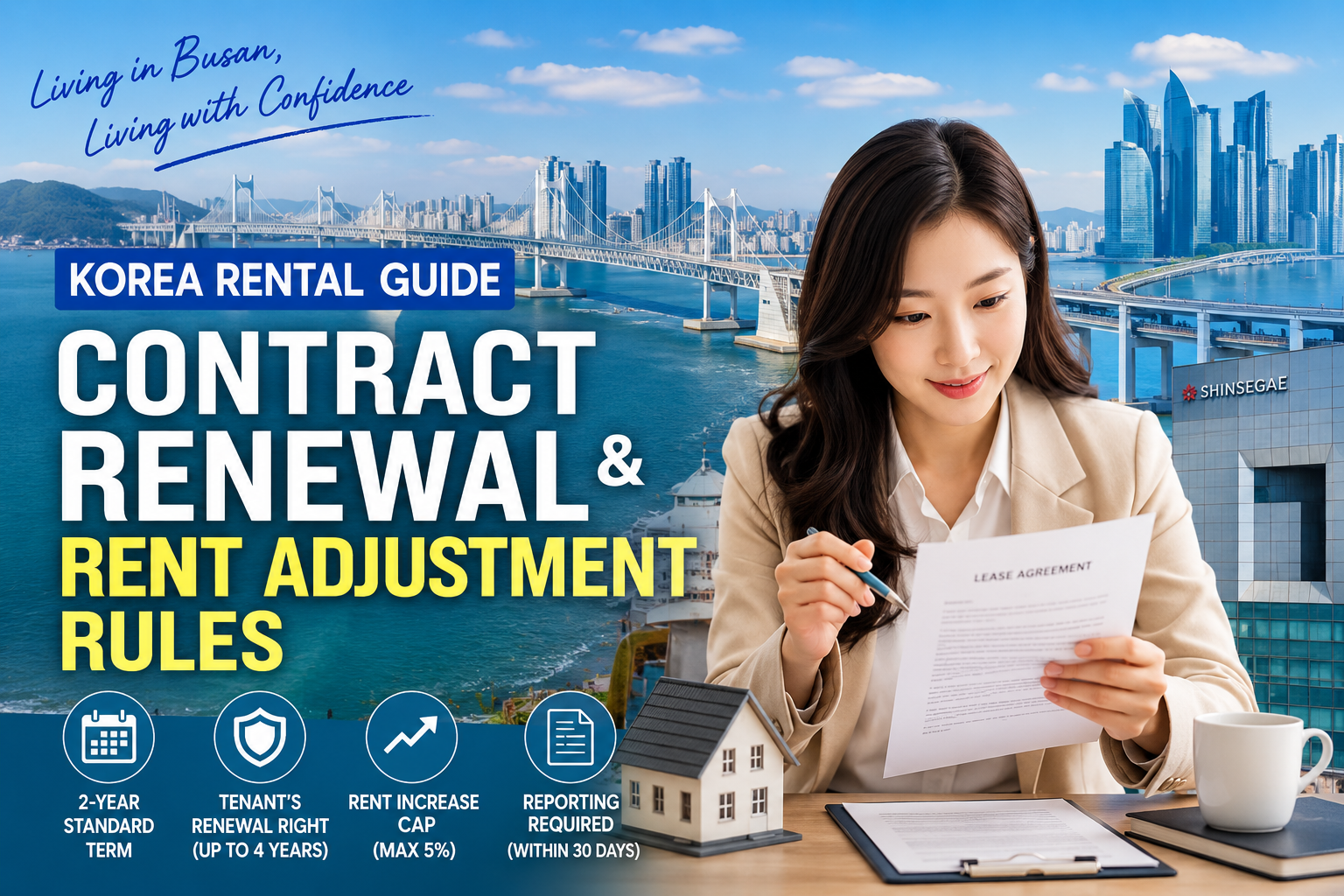
Most residential lease contracts in Korea follow a 2-year standard term.
- Typical structure:
- Contract duration: 2 years
- Deposit: Lump-sum (jeonse) or partial (wolse)
- Monthly rent: Optional (wolse only)
- Written contract: Required in practice
At the end of the contract, tenants and landlords must decide whether to:
- Renew the contract
- Adjust the terms
- Terminate the lease
This decision point is where renewal rules apply.
3. Tenant’s right to request renewal
(계약갱신요구권, Contract Renewal Request Right)
One of the most important legal protections for tenants in Korea is the right to request contract renewal.
Key features:
- Tenants can request one additional 2-year renewal
- Total guaranteed occupancy: up to 4 years (2 + 2)
- Landlords generally must accept the request
Conditions:
The tenant must:
- Request renewal within a specific period
(typically 6 months to 2 months before contract expiration) - Not have violated major contract terms
(e.g., unpaid rent, illegal use)
4. When landlords can refuse renewal
Although the tenant has a strong renewal right, there are limited exceptions where a landlord may refuse.
Common legally recognized reasons include:
- The landlord (or close family) intends to personally occupy the property
- The tenant has seriously breached the contract
- The property will undergo major reconstruction or demolition
These exceptions are interpreted relatively strictly in practice, meaning refusal is not freely allowed.
5. Rent increase limits during renewal
(임대료 증액 제한, Rent Adjustment Cap)
When a contract is renewed under the tenant’s request right, rent increases are restricted.
Legal cap:
- Maximum increase: 5%
- Applies to:
- Deposit (jeonse)
- Monthly rent (wolse)
Example:
- Current deposit: 100 million KRW
- Maximum increase: 105 million KRW
This rule is designed to prevent sudden rent spikes and provide predictability for tenants.
6. Rent adjustments outside renewal rights
Not all renewals are subject to the 5% cap.
There are two main scenarios:
1) Renewal under tenant’s request right
- 5% cap applies
- Strong tenant protection
2) Mutual agreement renewal (no formal request)
- No strict legal cap
- Rent may reflect market conditions
In practice, many contracts fall into the second category if:
- The tenant does not formally exercise the renewal right
- Both parties negotiate new terms freely
7. Deposit vs. monthly rent adjustments
Korean leases allow flexible restructuring between deposit and rent.
This means:
- Deposit can increase while monthly rent decreases
- Or monthly rent increases with a lower deposit
This conversion is often based on a standard interest rate framework, though actual terms vary.
Example structure:
- Higher deposit → lower monthly rent
- Lower deposit → higher monthly rent
This flexibility is a key feature of Korean leasing, but it also means tenants should carefully review financial implications at renewal.
8. Reporting obligations
(임대차 신고, Lease Reporting Requirement)
In many areas of Korea, lease contracts must be reported to the government.
When reporting is required:
- New contracts
- Renewals with changed terms
- Significant rent adjustments
Key points:
- Deadline: Typically within 30 days of signing
- Parties responsible: Both landlord and tenant (in principle)
- Purpose:
- Transparency in the housing market
- Data collection for public policy
Failure to report may result in administrative penalties.
9. Practical timeline for renewal decisions
Understanding timing is critical.
Typical renewal timeline:
- 6–2 months before expiration
- Tenant may request renewal
- Before contract end
- Parties finalize renewal or termination
- After renewal agreement
- Report contract if required
If no clear communication occurs, disputes may arise about whether renewal rights were properly exercised.
10. Common misunderstandings
Foreign residents often encounter confusion due to differences from other countries.
Misunderstanding 1:
“Rent can always increase freely at renewal”
→ Not true if the tenant uses the renewal request right
Misunderstanding 2:
“Renewal is automatic”
→ Not automatic; it must be requested or agreed
Misunderstanding 3:
“Deposit and rent are fixed structures”
→ In Korea, they are negotiable and convertible
11. Disputes and practical considerations
Even with clear legal rules, disputes can arise in areas such as:
- Whether the tenant properly exercised the renewal right
- Whether a landlord’s refusal is valid
- Whether rent increases exceed legal limits
In practice, many issues depend on:
- Timing of communication
- Written evidence (messages, notices)
- Contract wording

12. Final structural takeaway
The Korean lease renewal system can be summarized as follows:
- Baseline: 2-year contract
- Protection layer: One-time renewal right (up to 4 years total)
- Control mechanism: 5% rent increase cap (under renewal right)
- Flexibility: Deposit and rent can be restructured
- Oversight: Lease reporting system
Understanding this structure helps foreign residents navigate housing decisions with greater clarity and stability.


