Lease Term and Contract Duration in Korea
Understanding lease terms and contract duration is essential when renting housing in Korea. Unlike some countries where lease structures are relatively uniform, Korea has a distinct system shaped by legal protections, customary practices, and contract flexibility. This guide explains how lease periods are structured, how they can be renewed, and what legal frameworks apply, especially for foreign residents unfamiliar with the system.
1. Basic Structure of Lease Terms
In Korea, residential lease contracts are generally based on two main systems:
- Jeonse (전세): A large deposit-based lease with little or no monthly rent
- Wolse (월세): A lease involving monthly rent, usually with a smaller deposit
Regardless of the payment structure, the contract duration (임대차 기간) is a key element that defines the legal relationship between tenant and landlord.
Standard Contract Duration
The most common lease term in Korea is:
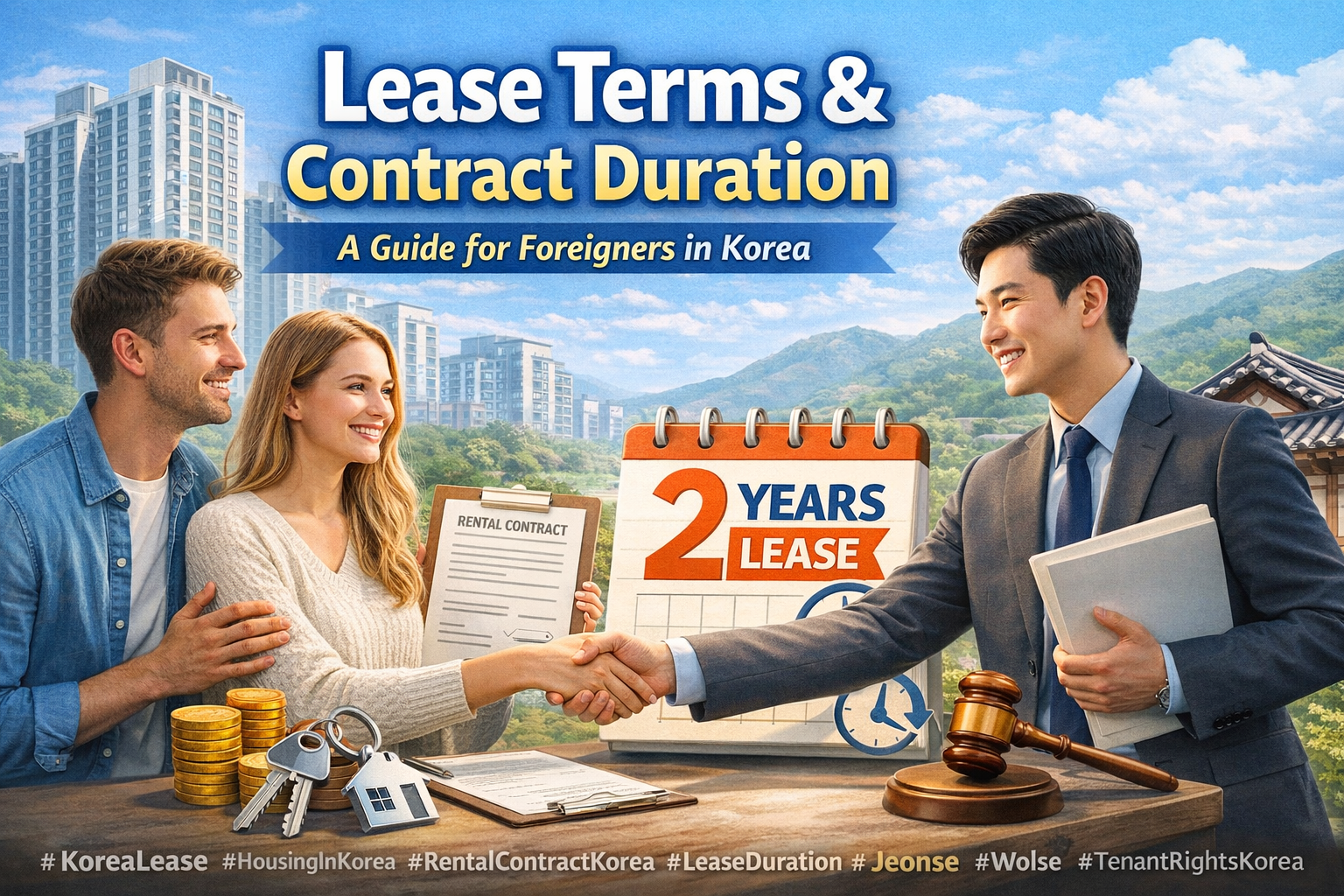
- 2 years (2-year fixed term)
This standard is not arbitrary—it is closely tied to the legal framework under the Housing Lease Protection Act (주택임대차보호법). Even if a contract specifies a shorter duration, the law may still recognize certain minimum protections for tenants.
2. Legal Minimum Lease Period
Under Korean law, tenants are protected by a minimum lease duration rule:
- If the contract period is less than 2 years, the tenant may still have the right to remain for up to 2 years, unless they voluntarily agree otherwise.
This means:
- A 1-year contract does not automatically limit the tenant’s stay to 1 year.
- The tenant can request to stay for the full 2-year period under legal protection.
This rule is designed to provide housing stability and prevent frequent forced moves.
However, this protection applies primarily when:
- The tenant has taken possession (점유) of the property
- The tenant has completed resident registration (전입신고)
These steps are important for establishing legal protection and priority rights.
3. Contract Renewal System
One of the most important features of Korean lease contracts is the renewal right system.
Right to Request Renewal
Tenants generally have the right to request a contract renewal:
- Known as the Contract Renewal Request Right (계약갱신요구권)
- Allows the tenant to extend the lease once for an additional 2 years
This means:
- A tenant can effectively stay for up to 4 years (initial 2 years + renewal 2 years)
Conditions and Limitations
The landlord may refuse renewal only under specific conditions, such as:
- The landlord or their immediate family intends to personally occupy the property
- The tenant has significantly violated contract terms (e.g., non-payment of rent)
Outside of these limited cases, refusal may not be legally valid.
4. Rent Adjustment Upon Renewal
When a lease is renewed, the landlord may adjust the rent, but there are limits:
- Rent increase is generally capped at 5%
- Applies to both deposit and monthly rent (depending on structure)
This cap helps prevent sudden and excessive rent increases during renewal.
However, the actual adjustment may vary depending on:
- Local government regulations
- Market conditions (though not directly enforceable beyond legal limits)
5. Early Termination and Contract Flexibility
Although lease contracts are typically fixed-term, early termination is possible under certain circumstances.
Tenant-Initiated Termination
A tenant may terminate the lease before the end of the term, but:
- The tenant may need to find a replacement tenant
- Or negotiate with the landlord
- In some cases, financial penalties may apply
Landlord-Initiated Termination
Landlords generally cannot terminate the lease early without valid legal grounds. This reinforces tenant stability.
6. Automatic Renewal and Holdover Status
If neither party explicitly terminates or renews the contract at the end of the lease term:
- The contract may enter a tacit renewal (묵시적 갱신) state
In this situation:
- The contract continues under the same conditions
- Either party may terminate the contract with notice (usually 3 months)
This provides flexibility but also requires awareness from both parties.
7. Reporting Obligations and Legal Recognition
To ensure full legal protection, tenants must complete certain administrative steps.
Key Requirements
- Resident Registration (전입신고)
- Date Certification (확정일자)
These steps help establish:
- Opposability (대항력): The right to assert the lease against third parties
- Priority Right (우선변제권): The right to receive deposit repayment before others in case of foreclosure
Without these, even a valid contract may lack full legal protection.
8. Practical Timeline of a Lease
A typical lease process in Korea follows this timeline:
- Contract signing (임대차계약 체결)
- Deposit payment (보증금 지급)
- Move-in and possession (입주 및 점유)
- Resident registration and date certification
- Lease period (typically 2 years)
- Renewal request (if applicable)
- Termination or extension
Understanding this sequence helps avoid common misunderstandings.
9. Key Considerations for Foreign Tenants
Foreign residents should pay particular attention to:
- Ensuring proper registration procedures are completed
- Understanding the renewal system, which may differ from their home country
- Clarifying contract terms in advance, especially regarding duration and renewal
It is also important to note that lease contracts may be written in Korean, so careful review is necessary.

Conclusion
Lease term and contract duration in Korea are governed by a combination of legal protections and established practices. While the standard contract period is 2 years, tenants may benefit from additional rights such as renewal options and minimum protection periods.
From a structural perspective, the key is not just the length of the contract itself, but how it interacts with legal safeguards like renewal rights, registration requirements, and deposit protection mechanisms.
Understanding these elements allows tenants to navigate the system more effectively and maintain stable housing during their stay in Korea.


