1. What “Resident Registration” Means for Foreigners
In Korea, “resident registration” does not mean the same thing for foreigners as it does for Korean nationals.
Foreign residents are registered through the immigration system, not the national resident registration system.
For foreigners, resident registration is handled by:
- Alien Registration / Foreigner Registration
- Issuance of a Residence Card
- Registration of address (place of stay)
This process creates your official administrative identity in Korea and allows government agencies, banks, hospitals, and service providers to recognize you as a lawful resident.
2. Who Must Register
You are required to register if you:
- Stay in Korea longer than 90 days, and
- Hold a mid- to long-term visa (work, study, family, investment, etc.)
Short-term visitors (tourist or short-term business visas) are not eligible for resident registration.
3. Legal Basis and Responsible Authority
Resident registration for foreigners is managed by:
- Immigration Offices under the Ministry of Justice
- The national immigration platform HiKorea (online administration)
Registration is governed by Korea’s Immigration Control Act and related regulations.
Local district offices (community centers) do not issue resident registration numbers to foreigners.
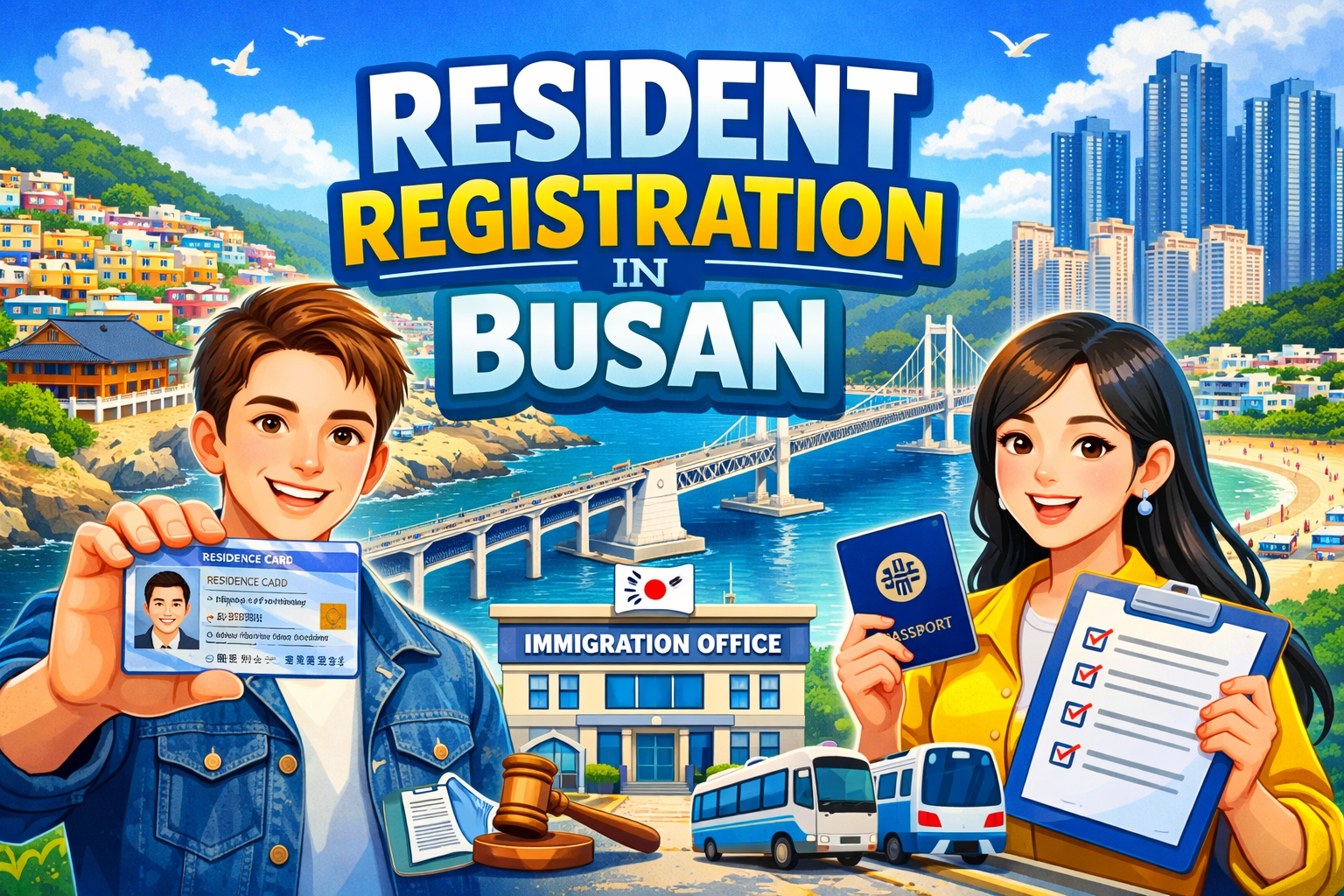
4. Key Registration Document: Residence Card
After registration, you receive a Residence Card, which functions as your primary identification in Korea.
The card includes:
- Your name (Roman alphabet)
- Nationality
- Visa type and status of stay
- Period of stay
- Registered address
- Alien Registration Number (unique ID)
This card is required for almost all administrative and daily activities.
5. Registration Deadline
Foreigners must apply for registration:
- Within 90 days of arrival in Korea, or
- Immediately after receiving a new eligible visa inside Korea
Failure to register on time may result in administrative penalties.

6. Where to Register in Busan
Registration is handled by the Busan Immigration Office with jurisdiction based on your address.
Typical locations include:
- Busan Immigration Office (main branch)
- Designated regional immigration offices
Appointments are usually required and can be made online through HiKorea.
7. Required Documents (General)
While requirements may vary by visa type, the following are commonly required:
- Valid passport
- Application form for alien registration
- One recent passport-style photograph
- Proof of address (lease contract, housing confirmation, or residence verification)
- Visa-related documents (employment contract, school enrollment, family relation proof, etc.)
- Registration fee
Original documents are typically required at the appointment.
8. Address Registration (Place of Stay Reporting)
Foreigners must report their place of stay after registration.
Key points:
- The registered address must reflect your actual residence
- Address changes must be reported within 14 days
- Reporting can be done:
- At the immigration office, or
- Online via HiKorea (depending on visa type)
Failure to update your address can affect visa status and future applications.
9. Differences from Korean Resident Registration
Foreign resident registration differs in several important ways:
- No 주민등록번호 (Korean national ID number)
- Registration managed by immigration authorities, not local governments
- Residence card replaces national ID
- Address data is shared with limited government systems
Despite these differences, the residence card is widely accepted for identification.
10. Why Registration Is Important
Without proper registration, you may face difficulties with:
- Opening bank accounts
- Signing housing contracts
- Mobile phone and internet subscriptions
- Health insurance enrollment
- Employment verification
- Tax and social security registration
In practice, the residence card functions as your gateway document for life in Korea.
11. Registration and Health Insurance
Once registered:
- Long-term residents are generally enrolled in National Health Insurance
- Enrollment may be automatic or require additional steps, depending on visa type
- Insurance status is linked to your registered address and stay period
Registration is therefore a prerequisite for accessing Korea’s public healthcare system.
12. Changes That Require Notification
You must notify immigration authorities if you experience:
- Change of address
- Change of workplace or school
- Change of passport
- Extension or change of visa status
- Loss or damage of residence card
Most changes have strict reporting deadlines.

13. Renewal and Reissuance
Your residence card is tied to your visa period.
- Visa extensions require updating your registration
- Lost or damaged cards must be reissued
- Outdated information must be corrected promptly
Always verify the expiration date on your card.
14. Practical Tips for New Residents
- Register as early as possible after arrival
- Keep digital copies of all submitted documents
- Check appointment availability in advance
- Use official immigration platforms for updates
- Track reporting deadlines carefully
Accurate registration reduces administrative risks and delays.
15. Summary
Resident registration for foreigners in Busan is a mandatory administrative process managed by immigration authorities.
It establishes your legal identity, connects you to public systems, and enables everyday life in Korea.
Understanding the structure, deadlines, and responsibilities helps ensure stable and compliant residency.


